
Peoria has grown into one of the most established and sought-after communities in the northwest Valley — well-planned neighborhoods, strong schools, proximity to the Lake Pleasant Recreation Area, and a residential character that attracts homeowners who take pride in their properties. But the same Sonoran Desert climate that makes Peoria’s outdoor lifestyle exceptional is quietly working against every roof in the city, every single day.
Roofing in Peoria AZ sits at the intersection of two realities that most homeowners do not fully reconcile until something goes wrong. The first is that Peoria’s roofs are among the most visually well-maintained in the Valley — neighborhoods where curb appeal matters and properties are kept in excellent condition. The second is that the most consequential roofing damage in Peoria happens invisibly, beneath tiles that look fine from the street, inside flashing joints that appear intact, and underneath ridge mortar that has been cracking from thermal stress for years without anyone noticing.
This guide gives Peoria homeowners the complete picture of what roofing in their specific market involves — what the desert does to roofs here, what services are available and what they cost, and how to find and evaluate a roofing contractor who genuinely understands what Peoria’s climate demands.
What Peoria’s Climate Does to Residential Roofs
Peoria sits in the northwest Valley in the heart of the Sonoran Desert, and its roofing environment reflects conditions that most of the country never experiences. The forces working against every Peoria roof operate simultaneously, continuously, and with an intensity that significantly exceeds what most roofing product specifications were developed to address.
UV intensity: Peoria receives approximately 300 days of sunshine per year. That sustained UV radiation attacks polymer-based roofing components — underlayment, sealants, asphalt shingle surfaces — at rates that far exceed product specifications developed for moderate climates. Sealants at flashing transitions that might last a decade in a northern state can become brittle and cracked within five to seven years under Peoria’s UV exposure.
Extreme attic heat: On a peak summer afternoon with outdoor temperatures at 110 degrees Fahrenheit, an inadequately ventilated Peoria attic routinely reaches 150 to 165 degrees. At those temperatures, underlayment polymers break down, deck adhesives delaminate, and every heat-sensitive component in the roof assembly ages at an accelerated rate. The relationship between attic ventilation and roof heat in Arizona is one of the most important dynamics any Peoria homeowner can understand — because inadequate ventilation compresses roof component life significantly and will repeat the same shortened outcome on any new system installed above it without correction.
Thermal cycling: Peoria’s daily temperature swing of 30 to 40 degrees between afternoon peak and nighttime low causes every component of the roof assembly to expand and contract continuously. Fasteners loosen, flashing gaps open, ridge mortar cracks, and underlayment separates at laps and penetrations — creating the water entry points that monsoon rain finds efficiently.
Monsoon season: From mid-June through late September, Peoria’s monsoon season brings sudden violent storms with wind gusts exceeding 60 miles per hour and rainfall intense enough to overwhelm drainage systems in minutes. The northwest Valley is particularly exposed to haboob dust storms that roll in from the desert ahead of monsoon fronts — abrasive silica particles that erode granule surfaces, clog drainage systems, and infiltrate loose flashing joints. Understanding how Phoenix area heat reduces roof lifespan gives Peoria homeowners the foundational context for every roofing decision they face.
Roofing Services Available in Peoria AZ
Peoria’s residential roofing market covers every service category — from routine maintenance and targeted repair through full replacement and flat roof system installation. Understanding what each service involves and when it is the appropriate response is the foundation of every sound roofing decision.
Roof Inspection
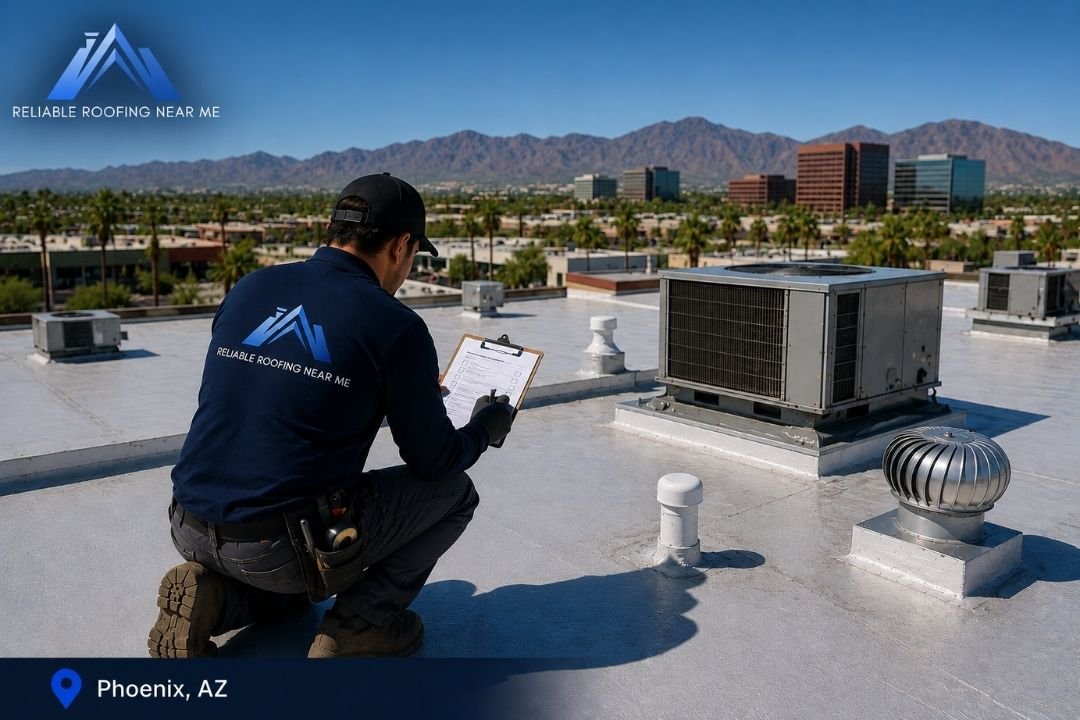
A professional roof inspection is the starting point for every other roofing decision. In Peoria’s climate — where the most significant damage develops invisibly beneath the surface — an inspection that only looks at what is visible from the ground is not an inspection. A thorough professional inspection in Peoria lifts tiles in representative areas to assess underlayment condition directly, checks the attic for moisture evidence and structural stress, evaluates flashing sealant condition at every penetration and transition, assesses attic ventilation adequacy against code requirements, and examines ridge and hip mortar condition.
For Peoria homeowners with roofs more than 15 years old, a professional inspection every two to three years is a sound maintenance investment — and a post-storm inspection after any significant monsoon event is worthwhile regardless of the roof’s age. Our Phoenix metro roof inspection checklist outlines everything a thorough professional inspection should cover and gives you the framework to evaluate whether any inspector’s process is genuinely comprehensive.
Roof Repair
Targeted roof repair is the appropriate response when damage is genuinely isolated — a specific flashing location, a section of cracked or displaced tiles, a localized flat roof membrane failure — and when the overall roof system including underlayment is in acceptable condition for the age of the installation.
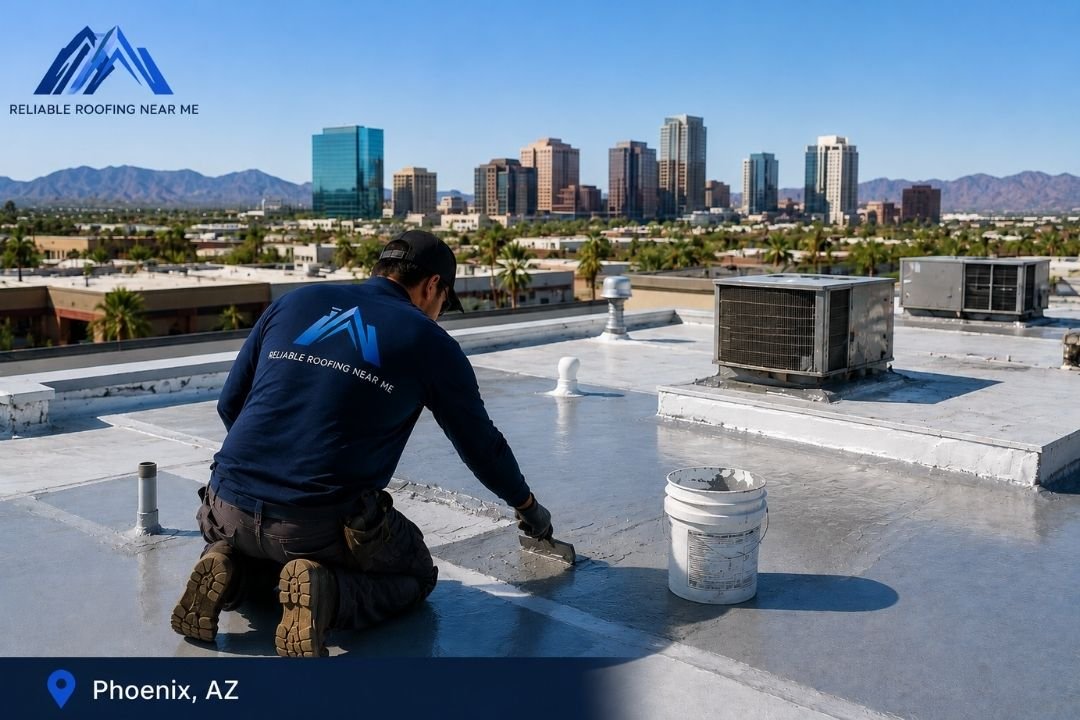
The most common repair types on Peoria residential roofs include individual tile replacement for cracked or displaced units, ridge and hip mortar repointing as thermal cycling degrades the cement, flashing sealant renewal at pipe boots, skylight perimeters, and wall-to-roof step flashings, and flat roof membrane repairs on garage and addition sections. Our guide on roof flashing repair: signs, costs and what to do covers the most common repair type in Peoria’s market in full detail.
The critical caveat for Peoria repair decisions: a repair that addresses the visible symptom without confirming the condition of the underlayment beneath is a repair that may return with the next monsoon storm. Recurring leaks that repair has not resolved are almost always indicating that the actual source — failed underlayment or compromised flashing — has not been reached by the repair work. Our guide on why roof leaks happen and how to fix them covers the diagnostic process for identifying the actual source of persistent leaks.
Tile Roof Underlayment Replacement
This is the most significant and most commonly deferred roofing service across Peoria’s established neighborhoods — and the one that creates the most expensive surprises when it is addressed reactively rather than proactively.
Peoria’s residential development history means a large number of homes carry tile roofs installed in the late 1980s through the early 2000s. Many of those roofs are now at or past the 20 to 25-year underlayment service life that Arizona’s attic heat conditions impose on most underlayment products. The tiles above those roofs frequently look intact — because tile is genuinely durable in Arizona’s climate. The underlayment beneath them may have been failing for years.
Tile underlayment replacement — removing existing tiles, stripping failed underlayment, inspecting and repairing the deck, installing new underlayment, and relaying the tiles above — is the correct response when the underlying membrane has reached the end of its reliable service life. In most cases, 85 to 95 percent of existing tiles are salvaged and reused, which keeps total project cost significantly lower than full material replacement. Our guide on when to replace tile roof underlayment in Arizona covers the specific indicators, age thresholds, and cost ranges that Peoria homeowners need to understand before this decision arrives.
Full Roof Replacement
When the roofing system has deteriorated beyond the point where targeted repair or underlayment replacement is sufficient — when tile itself has reached the end of its structural life, when deck damage requires extensive remediation, or when the homeowner chooses to change the roofing material — a full replacement is the appropriate scope.
For Peoria homeowners in HOA communities, full replacement triggers the HOA approval process in virtually every case — material type, color, and profile must all be confirmed as compliant with the community’s architectural standards before any contractor ordering or installation begins. Understanding the decision framework for Phoenix roof replacement vs repair is foundational to evaluating whether your specific situation calls for full replacement or a more targeted scope.
Flat Roof Repair and Replacement
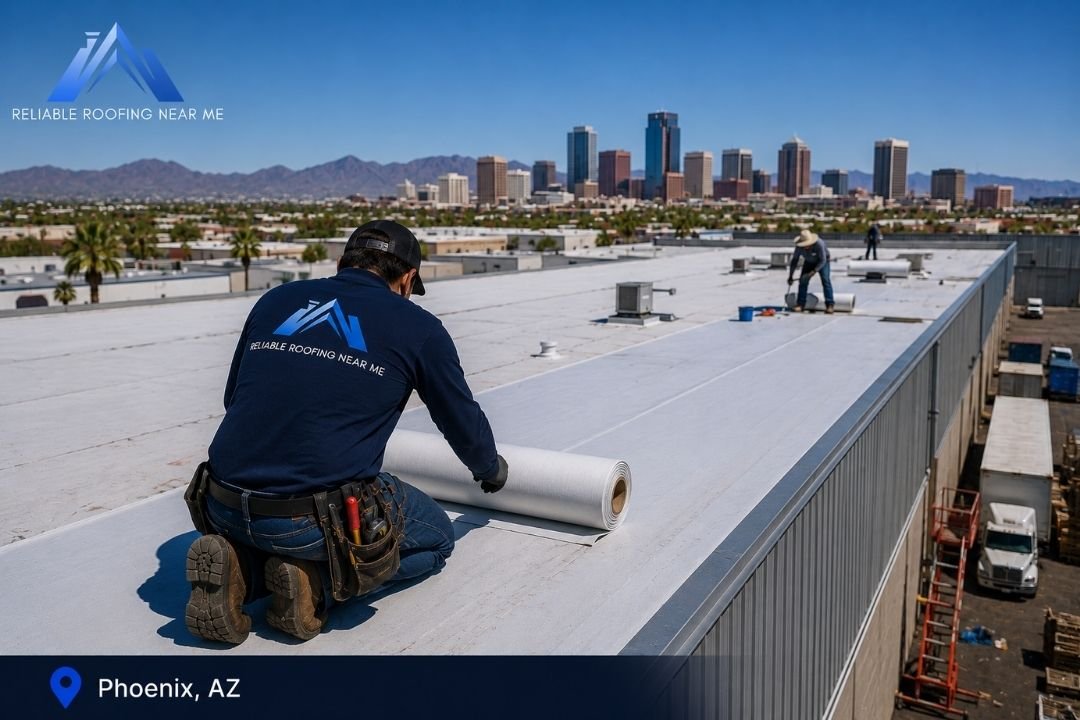
Many Peoria homes have flat or low-slope sections on garages, room additions, RV covers, and covered patios that require dedicated flat roofing systems — TPO, spray polyurethane foam, or modified bitumen — rather than the tile systems used on the primary sloped roof.
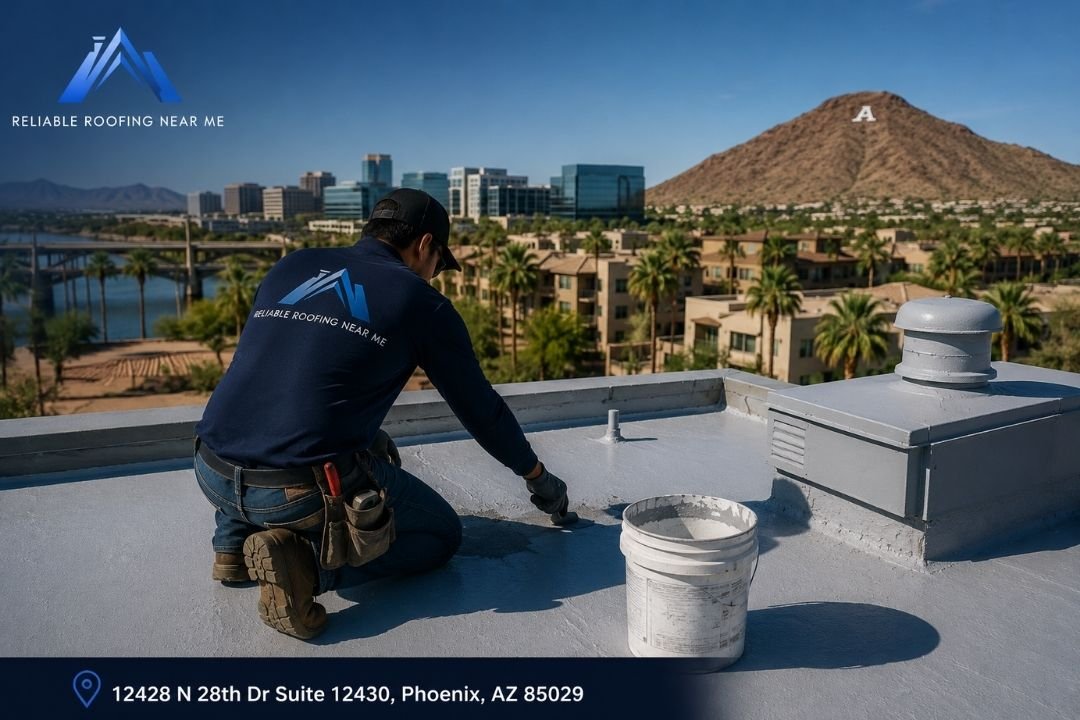
These sections are frequently the most neglected areas on Peoria residential properties and among the most vulnerable to monsoon water intrusion when their membrane systems fail. For Peoria homeowners evaluating flat roof options, our comparisons of TPO roofing pros and cons in Phoenix AZ, foam roof coating costs in Phoenix, and TPO vs foam vs modified bitumen for Phoenix homes provide the information needed to evaluate which system is most appropriate for each flat roof application.
Roofing Costs in Peoria AZ
Understanding current pricing in Peoria’s market gives you the reference point to evaluate any contractor estimate accurately before committing to a project. The figures below reflect current northwest Valley market rates for labor and materials.
Professional roof inspection: $150 to $400 for a thorough inspection with written report covering all roof system components
Individual tile replacement: $35 to $150 per tile depending on profile, color matching difficulty, and number of tiles being replaced in a single visit
Ridge and hip mortar repointing: $400 to $1,200 for a full repoint on a standard Peoria residential roof depending on linear footage
Flashing repair (per location): $150 to $400 for pipe boot replacement, $300 to $900 for skylight flashing, $400 to $1,500 for chimney flashing depending on scope
Tile underlayment replacement (complete tile relay): $9,000 to $18,000 for a standard 2,000 square foot Peoria home depending on underlayment product, deck condition, and tile salvage rate
Full concrete tile replacement: $16,000 to $24,000 for a standard 2,000 square foot Peoria home
Full clay tile replacement: $24,000 to $40,000 for a standard 2,000 square foot Peoria home
Asphalt shingle replacement: $10,000 to $16,000 for a standard 2,000 square foot Peoria home
Metal roofing installation: $20,000 to $36,000 for a standard 2,000 square foot Peoria home
Flat roof TPO installation: $5,500 to $12,000 for a standard flat section depending on size and existing substrate condition
Foam roof coating installation: $6,000 to $12,000 for a standard flat section depending on size and coating specification
All figures reflect current Peoria market pricing. Actual costs vary based on roof size, pitch, complexity, and conditions discovered during the project. Additional costs to factor in include Maricopa County building permits at approximately $150 to $200 for standard residential re-roof projects, deck repair if structural damage is discovered at $500 to $3,000 or more depending on extent, attic ventilation improvements if deficiencies are identified at $500 to $1,500, and HOA application or approval fees where applicable. Our detailed guides on roof repair costs in Phoenix metro and roof replacement costs in Phoenix metro provide additional pricing context across the Valley.
Peoria HOA Roofing Requirements
A significant portion of Peoria’s residential neighborhoods — from Vistancia and Westwing Mountain to Terramar and Fletcher Heights — operate under HOA governance with specific requirements for roofing materials, colors, profiles, and contractor documentation. Roofing in Peoria AZ within an HOA community is not simply a matter of choosing a contractor and scheduling work — it is a process that begins with the HOA approval before any other step proceeds.
The most important principle for Peoria HOA roofing projects is straightforward: no work begins without written HOA approval in hand. A homeowner who allows roofing work to begin before the architectural review committee has issued written approval risks fines, stop-work orders, and in serious cases mandatory removal of non-compliant work at their own expense — paying for a roof twice is the most expensive possible outcome of bypassing the approval process.
Material restrictions in Peoria HOA communities most commonly require specific tile types, profiles, and colors that reflect the community’s architectural character. Confirming the exact approved specifications for your community before any contractor materials ordering occurs eliminates the risk of installing a non-compliant product that triggers a compliance action after the work is complete.
Our complete guide on HOA roofing rules in Phoenix Arizona covers the approval process, documentation requirements, common compliance mistakes, and the appeal process for HOA denials across Valley communities including Peoria’s established HOA landscape.
Insurance and Roofing in Peoria AZ
Peoria’s monsoon season creates the conditions for legitimate insurance-covered roofing claims — wind damage, hail impact, and storm debris are all covered perils under standard Arizona homeowner’s insurance policies. But navigating the claims process correctly is what determines whether the outcome is a funded replacement or a denied claim.
The steps that matter most for Peoria homeowners pursuing an insurance-covered roofing claim include documenting damage with photographs immediately after the storm event — before any temporary repairs are made, requesting a professional inspection and written damage assessment from a licensed roofing contractor before contacting the insurer, understanding the policy’s deductible and coverage limits before the adjuster visit, and working with a contractor experienced in the Arizona insurance claims process who can document covered damage accurately and communicate effectively with the adjuster.
Our step-by-step guide on the insurance claim process after a Phoenix monsoon covers every stage of the process. And our guide on whether home insurance covers roof replacement in Phoenix clarifies the coverage and exclusion landscape so Peoria homeowners know what to expect before filing.
One essential point: any roofing contractor in Peoria who offers to waive your insurance deductible as an inducement to hire them is violating Arizona law. Arizona Revised Statutes explicitly prohibit this practice. Walk away from any contractor making this offer and report it to the Arizona Department of Insurance.
Roofing Financing Options for Peoria Homeowners
A significant roofing project in Peoria — whether an underlayment replacement, a full tile re-roof, or a flat roof system installation — represents a major expense that not every homeowner is positioned to fund from cash on hand. Understanding the financing options available before the need arrives gives you the ability to make a sound decision without pressure when the project becomes necessary.
Contractor-arranged promotional financing, personal home improvement loans, home equity loans and HELOCs, and FHA Title I loans are all available to Peoria homeowners depending on their specific financial profile and project scope. Our complete guide on roofing financing options in Phoenix AZ covers every option in detail — including the deferred interest terms that catch homeowners off guard and the specific situations where each financing type makes the most sense for a Peoria roofing project.
What to Look for in a Roofing Contractor in Peoria AZ
Finding a roofing contractor in Peoria AZ who combines the licensing, experience, technical depth, and professional standards that a significant roofing investment deserves requires more than checking a review platform. The evaluation process that protects Peoria homeowners begins with verifiable credentials and extends through every aspect of how a contractor presents, estimates, and documents their work.
Active Arizona ROC License
The baseline requirement for any roofing contractor performing work in Peoria is an active Arizona ROC license. Performing roofing work without one is illegal in Arizona. Verify the license at the official Arizona Registrar of Contractors website before any other evaluation proceeds — it takes 60 seconds and is non-negotiable. Our guide on finding a licensed roofing contractor in Arizona walks through the verification process step by step. At Reliable Roofing Near Me, our license number is ROC 355096 — active, in good standing, and verifiable at any time.
Insurance Certificates
Request current certificates of general liability insurance and workers’ compensation coverage before any work begins. Both are required — general liability protects you from property damage caused during the project, and workers’ compensation protects you from liability if a worker is injured on your property. A contractor who cannot or will not provide current certificates should not access your Peoria roof.
Written Itemized Estimates
Every estimate for roofing work in Peoria should be written and itemized — specifying the exact materials to be used, the complete scope of preparation work, permit handling, warranty terms for both materials and workmanship, and a clear project timeline. A one-number quote with no material specification or scope detail is not an estimate. Collect a minimum of two written estimates before committing to any Peoria roofing project and evaluate them against current market pricing benchmarks.
Permit Handling
Full roof replacements and most significant roofing work in Peoria require a Maricopa County building permit filed before work begins. A professional roofing contractor handles permit filing as standard practice. Any contractor who suggests permits are unnecessary or asks you to handle the permit yourself is cutting a corner that creates real consequences for you as the property owner. Our guide on Phoenix area roof permits covers exactly what is required and what unpermitted work means for your property.
Ventilation Assessment
A roofing contractor in Peoria AZ who does not assess attic ventilation as part of every significant roofing project is missing one of the most consequential factors in roof system longevity in this climate. Ask every contractor you evaluate whether ventilation assessment is part of their standard inspection and project scope process. A contractor who engages knowledgeably with that question — who understands the relationship between roof ventilation in Phoenix AZ and material performance — is demonstrating the technical depth that matters for long-term performance of your Peoria roof.
Local References
A contractor with a genuine Peoria track record provides references readily from Peoria and northwest Valley homeowners with similar project types. Follow up on those references — a brief conversation with a previous customer is one of the most reliable quality indicators available. Our complete guide on how to choose the best roofing contractor in Phoenix AZ covers the full evaluation framework for any Peoria roofing project.
Red Flags to Watch for in Peoria’s Roofing Market
No ROC license or reluctance to provide it. Disqualify immediately. There is no legitimate reason a professional roofing contractor cannot provide an active ROC license number on request.
High-pressure same-day decision demands. Artificial urgency is a sales tactic, not a service standard. A contractor worth hiring gives you time to review estimates and make an informed decision without pressure.
Significantly below-market bids without explanation. A quote that is materially below every other estimate warrants specific scrutiny about what it excludes — lower-grade materials, skipped preparation, no permit filing, or unlicensed subcontractors are the common explanations for unusually low numbers in Peoria’s market.
Deductible waiver offers. Illegal under Arizona law. Walk away immediately and report to the Arizona Department of Insurance.
Verbal-only warranty terms. A warranty that is not in writing before work begins is not a warranty that will protect you. Written warranty documentation for both materials and workmanship is a baseline expectation from any professional Peoria roofing contractor. Understanding what voids roof warranty in Arizona helps you evaluate whether any contractor’s proposed approach preserves your coverage fully.
No mention of permits for full replacement work. Unpermitted roofing work on your Peoria property creates complications at the point of sale and may void material warranties. The permit obligation falls on the homeowner — not on a contractor who is long gone by the time the complication surfaces.
Roof Maintenance for Peoria Homeowners
The most cost-effective approach to roofing in Peoria’s climate is a proactive maintenance schedule that catches developing issues at the point where they are inexpensive to address — not at the point where they have compounded into structural problems that require major remediation.
For Peoria homeowners, a professional inspection every two to three years and a post-storm inspection after any significant monsoon event is the maintenance cadence that delivers the best return on investment. Our Phoenix metro roof maintenance checklist outlines every item a thorough maintenance visit should cover. And our guide on getting your roof ready for Phoenix metro summer heat covers the specific pre-summer preparation tasks that reduce storm season risk for Peoria homes.
If your Peoria roof is approaching the 15 to 20-year mark, the single most important maintenance question is the condition of the underlayment beneath the tile. Addressing that question proactively — through a professional inspection that includes lifting tiles in representative areas — is far less expensive than discovering the answer through interior water damage during monsoon season.
Frequently Asked Questions
How long does a roof last in Peoria AZ?
Clay tile can last 50 to 100 years in Peoria’s climate with underlayment replaced at the appropriate 20 to 25-year interval. Concrete tile typically lasts 30 to 50 years. Asphalt shingles last 15 to 25 years in Peoria’s heat. Metal roofing lasts 40 to 70 years. The underlayment beneath tile — the actual waterproofing barrier — needs replacement every 20 to 25 years in Arizona’s attic heat conditions regardless of tile longevity. Our guide on how long a tile roof lasts in Arizona covers lifespan expectations in full detail.
Do I need a permit for roofing work in Peoria AZ?
Yes — for full roof replacements and most significant roofing work, a permit is required in Peoria through Maricopa County or the City of Peoria depending on your specific address. A licensed roofing contractor handles permit filing as standard practice before work begins. Minor repairs typically do not require a permit, but confirming with your contractor before assuming is always the prudent approach.
What is the most common roofing problem in Peoria AZ?
Tile roof underlayment failure is the most significant and most commonly deferred roofing problem across Peoria’s established neighborhoods. Tiles that look intact from the street can be sitting above underlayment that stopped performing years ago — and the evidence does not arrive until monsoon rain finds the gaps that failed underlayment creates. Flashing sealant failure at pipe boots, skylight perimeters, and wall-to-roof transitions is the most frequent individual repair type.
Does homeowner’s insurance cover roofing damage in Peoria AZ?
Standard Arizona homeowner’s insurance covers physical damage from specific covered events — monsoon wind, hail, falling debris — but excludes damage from normal wear, aging, and deferred maintenance. Documenting storm damage immediately after the event and requesting a professional written assessment before contacting the insurer are the most important steps for a successful Peoria insurance roofing claim.
When is the best time to replace a roof in Peoria AZ?
The optimal windows are late winter through spring — February through April — and fall — October through November. These periods offer cooler working temperatures and fall outside the peak monsoon season. If your roof is actively leaking or sustaining ongoing storm damage, replacement should not wait for an optimal season — addressing active water intrusion promptly is always the right call regardless of timing on the calendar.
How do I know if my Peoria roof needs replacement or just repair?
The key indicators that replacement rather than repair is the appropriate scope include a roof more than 20 years old with no documented underlayment replacement, recurring leaks that previous repairs have not resolved, moisture or structural damage visible in the attic, widespread tile or surface deterioration, and deck damage discovered during inspection. Our guide on Phoenix roof replacement vs repair walks through the complete decision framework.
Your Roofing Company in Peoria AZ
At Reliable Roofing Near Me, we serve Peoria homeowners across every neighborhood in the city — from Vistancia and Westwing Mountain to Terramar, Sunrise Mountain, and every community in between. We bring licensed, professional, and fully documented roofing service to every project we undertake — inspecting honestly, estimating transparently, installing correctly, and standing behind our work with written warranty terms that hold.
Whether you need a professional roof inspection, targeted roof repair, a complete roof installation, or honest guidance on whether your situation calls for repair or full replacement, we will give you a straight answer and a written estimate with no pressure and no obligation.
Call us at (480) 867-9986 or visit reliableroofingnearme.com to schedule your free Peoria roof inspection today. We serve Peoria, Glendale, Surprise, Phoenix, Scottsdale, Mesa, Chandler, Gilbert, Tempe, and every community across the Valley.
Reliable Roofing Near Me | (480) 867-9986 | reliableroofingnearme@gmail.com | reliableroofingnearme.com | 12428 N 28th Dr Suite 12430, Phoenix, AZ 85029 | ROC License #355096