
Mesa is the third-largest city in Arizona and one of the most densely established residential markets in the entire Valley. Decades of growth have produced neighborhoods across every era — from mid-century homes near downtown to the master-planned communities along the 202 corridor — and the roofs above those homes reflect that history. Some are relatively new. Many are aging. And a significant number are past the point where the homeowner realizes a replacement decision is already overdue.
Roof replacement in Mesa AZ is not a decision that announces itself with convenient timing. It arrives when underlayment fails silently beneath tiles that still look fine from the street. It arrives when a monsoon storm finds the gap that three years of thermal cycling created in a flashing seal. It arrives when water stains appear on a ceiling and the estimate that follows is larger than anyone planned for.
This guide gives Mesa homeowners the honest, complete picture of roof replacement — what drives the decision, which materials perform in Mesa’s specific climate, what a replacement actually costs in the current market, how to navigate the process from start to finish, and how to identify a contractor worth trusting with a project of this magnitude.
What Makes Mesa’s Roofing Environment Uniquely Demanding
Mesa sits squarely in the Sonoran Desert, and its roofing conditions are shaped by forces that operate simultaneously, continuously, and at intensities that most of the country never experiences. Understanding what your roof is actually up against is the foundation of every sound roofing decision.
UV radiation: Mesa receives approximately 300 days of sunshine per year. That relentless UV exposure attacks every polymer-based component in a roofing system — underlayment, sealants, shingle surfaces — at a rate that far exceeds the expectations built into product specifications developed for moderate climates. Sealants that might last a decade in a northern state can become brittle and cracked in five to seven years under Mesa’s UV intensity.
Extreme heat and attic temperatures: On a peak summer afternoon with outdoor temperatures at 110 degrees Fahrenheit, an inadequately ventilated Mesa attic can reach 150 to 165 degrees. At those temperatures, underlayment polymers break down, deck adhesives delaminate, and every heat-sensitive component in the roof assembly ages at an accelerated rate. Understanding the relationship between attic ventilation and roof heat in Arizona is foundational context for any Mesa homeowner making a roofing decision — because poor ventilation compresses roof component life significantly and will repeat the same outcome on whatever new system is installed above it.
Thermal cycling: Mesa’s daily temperature swing of 30 to 40 degrees between afternoon peak and nighttime low causes every component of the roof assembly to expand and contract continuously. Over years and decades, this movement works fasteners loose, opens gaps at flashing joints, cracks ridge mortar, and separates underlayment at laps and penetrations — creating the water entry points that monsoon rain exploits efficiently.
Monsoon season: From mid-June through late September, Mesa’s monsoon season delivers sudden violent storms with wind gusts exceeding 60 miles per hour and rainfall intense enough to overwhelm drainage systems in minutes. These storms test every weak point a roof has accumulated across the preceding year of thermal stress and UV exposure. Our guide on how Phoenix area heat reduces roof lifespan covers the full picture of what these combined forces do to roofing systems across their service life.
Signs Your Mesa Roof Needs Replacement Rather Than Repair
One of the most consequential decisions a Mesa homeowner makes is recognizing when repair is no longer the appropriate response — when the roofing system has deteriorated to the point where targeted fixes are buying time rather than solving the problem. Several clear indicators distinguish a replacement situation from a repair situation.
Age and Underlayment Service Life
In Mesa’s climate, tile roof underlayment has a realistic service life of 20 to 25 years. Asphalt shingle roofs typically last 15 to 25 years depending on installation quality, ventilation, and the specific product. If your Mesa roof is approaching or past these thresholds and the underlayment has never been replaced, the statistical probability of system-level deterioration is high — regardless of how the surface materials look from the ground.
For tile roofs specifically, the tile itself is rarely the limiting component. Clay tile can last 50 to 100 years in Arizona’s climate. Concrete tile typically lasts 30 to 50 years. The underlayment beneath those tiles — the membrane that actually keeps water out — fails decades before the tile does. A tile roof that needs attention at 20 to 25 years typically needs underlayment replacement, not tile replacement. Understanding when to replace tile roof underlayment in Arizona is one of the most important roofing concepts for any Mesa homeowner with tile above their head.
Recurring Leaks That Repair Has Not Resolved
A leak that has been patched more than twice without permanently resolving is almost always indicating that the actual source — typically failed underlayment or compromised flashing — has not been addressed by the repair work. Repeated tile-level repairs on a roof with failed underlayment are a temporary measure that defers the inevitable at increasing cost. If a leak has come back after multiple repair attempts, the conversation should shift to what the underlying system condition actually is — not what the next patch should be.
Interior Water Damage and Attic Moisture
Water stains on interior ceilings or walls that appear after monsoon events indicate active water intrusion that is damaging deck, framing, insulation, and interior finishes with every subsequent storm. Moisture visible in the attic after rain confirms that the waterproofing barrier has been breached. In both cases, the appropriate response is a professional inspection that assesses the full extent of the damage — not another targeted repair that addresses the visible manifestation without confirming the source.
Widespread Tile Damage or Surface Deterioration
Isolated cracked or displaced tiles are a repair situation. Widespread cracking, surface erosion, or displaced tiles across multiple sections indicate system-level deterioration that individual replacements will not adequately address. When tile damage is extensive, the underlayment assessment beneath those damaged areas is equally important — tiles that crack from thermal stress have often been protecting underlayment that has simultaneously been degrading from the same conditions.
Deck Damage Discovered During Inspection or Repair
When any roofing project exposes the deck and reveals delaminated plywood, soft spots, rotted sections, or darkened framing, those conditions indicate that water intrusion has been occurring for long enough to cause structural damage. Deck damage of this nature typically requires repair or partial replacement before any new roofing system can be installed properly — and its presence almost always indicates that targeted repair of the surface system is no longer the right approach.
Our guide on when to replace your roof in the Phoenix metro and our complete framework for Phoenix roof replacement vs repair give you the full decision toolkit for evaluating where your Mesa roof stands.
Best Roofing Materials for Mesa AZ
Not all roofing materials perform equally in Mesa’s desert climate, and the right choice depends on your home’s structure, your HOA requirements, your budget, and your long-term ownership horizon. Here is an honest assessment of the main options available to Mesa homeowners.
Clay Tile
Clay tile is the gold standard for Mesa’s climate — and for roofing performance in the Sonoran Desert generally. Fired to vitrification, clay tile is essentially impervious to UV radiation, does not absorb moisture, handles thermal cycling better than any polymer-based material, and carries through-body color that does not fade regardless of UV exposure duration. In Mesa’s climate, clay tile can realistically last 50 to 100 years with underlayment replaced at the appropriate 20 to 25-year interval.
The primary limitation of clay tile is cost. At $12.00 to $20.00 per square foot installed for a complete replacement, clay tile represents a significant upfront investment that is justified by its extraordinary longevity but may exceed the budget parameters of some projects. For Mesa homeowners in HOA communities — where tile is frequently required — clay tile is the highest-performing compliant option available.
Concrete Tile
Concrete tile is the most widely installed roofing material across Mesa’s established neighborhoods and represents the practical middle ground between clay tile’s performance and asphalt’s affordability. At $8.00 to $12.00 per square foot installed, concrete tile delivers genuine durability — a realistic lifespan of 30 to 50 years in Mesa’s conditions — at a significantly lower upfront cost than clay.
The specific limitations of concrete tile in Mesa’s climate include surface color fading over time — because concrete tile color is a surface slurry rather than a through-body characteristic — and slightly greater porosity than clay. Neither limitation is a structural concern, but both are worth understanding for long-term aesthetic planning and HOA compliance. Our detailed comparison of concrete tile vs clay tile roof in Arizona covers both materials in full detail.
Asphalt Shingles
Asphalt shingles remain the most affordable roofing option in Mesa at $5.00 to $8.00 per square foot installed and are appropriate for homes where HOA requirements permit them and where the budget does not accommodate tile. Modern architectural shingles designed specifically for high-heat climates perform significantly better in Mesa’s conditions than standard shingles, with realistic lifespans of 15 to 25 years when installed with proper underlayment and adequate attic ventilation.
Attic ventilation is particularly consequential for asphalt shingles in Mesa. An inadequately ventilated attic running at 160 degrees attacks asphalt shingles from below while UV attacks from above — compressing the lifespan significantly below what the product is rated for. Any asphalt shingle replacement in Mesa should include a ventilation assessment and correction of any deficiencies before the new shingles are installed. Our guide on roof ventilation in Phoenix AZ covers this requirement in full detail.
Metal Roofing
Metal roofing is gaining significant market share across Mesa and the broader East Valley — and the performance case in Arizona’s climate is compelling. Metal handles thermal expansion better than any other roofing material, reflects solar radiation effectively reducing cooling loads, and delivers lifespans of 40 to 70 years that make the higher upfront cost — $10.00 to $18.00 per square foot installed — economically competitive over a full ownership horizon.
For Mesa homeowners in HOA communities, confirming that metal roofing is on the approved materials list before any planning proceeds is essential. Many established HOA communities in Mesa have governing documents that predate metal roofing’s rise in the Arizona market and may not include it in their approved materials lists.
Flat Roof Systems
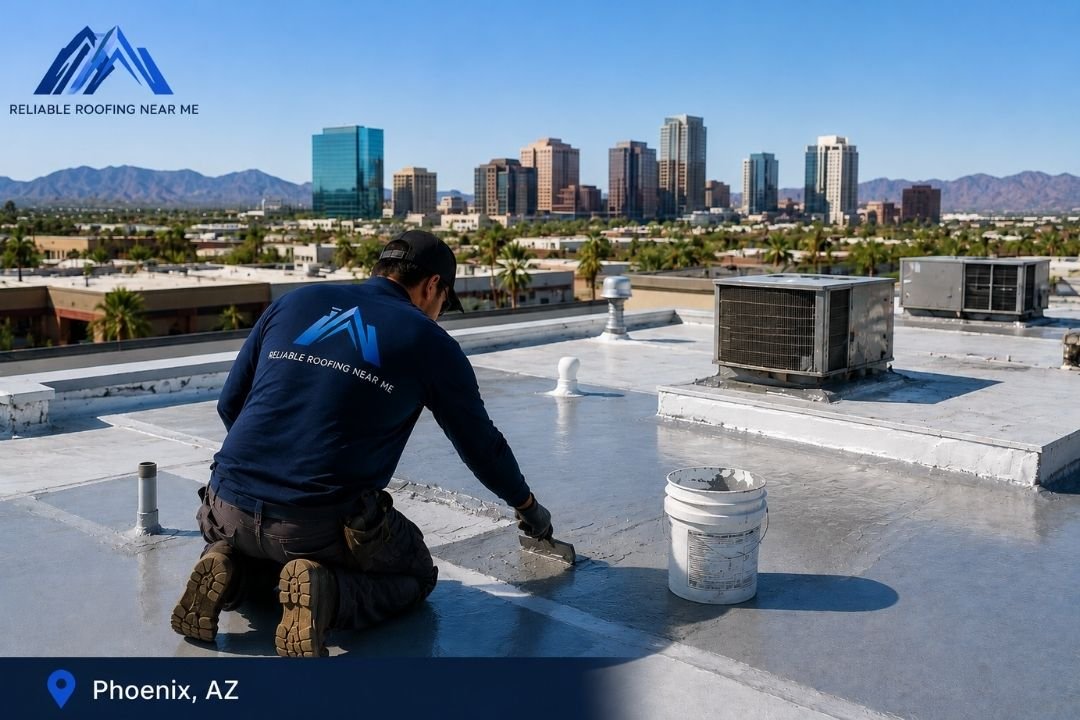
Many Mesa homes have flat or low-slope sections — on garages, additions, and covered patios — that require dedicated flat roofing systems. TPO, spray polyurethane foam, and modified bitumen are the primary options for these sections. Our guide on TPO vs foam vs modified bitumen for Phoenix homes gives Mesa homeowners a direct comparison of the available options for flat roof sections.
Roof Replacement Cost in Mesa AZ
Understanding current replacement costs in Mesa’s market gives you the reference point to evaluate any contractor estimate accurately before committing to a project.
Concrete tile replacement (complete, including underlayment and tile relay): $16,000 to $24,000 for a standard 2,000 square foot Mesa home
Clay tile replacement (complete, including underlayment and tile relay): $24,000 to $40,000 for a standard 2,000 square foot Mesa home
Asphalt shingle replacement (complete): $10,000 to $16,000 for a standard 2,000 square foot Mesa home
Metal roofing installation (complete): $20,000 to $36,000 for a standard 2,000 square foot Mesa home
Tile underlayment replacement only (tile relay, existing tile salvaged): $9,000 to $18,000 for a standard 2,000 square foot Mesa home depending on underlayment product and tile salvage rate
Additional costs to factor in:
- Deck repair if rot or structural damage is discovered: $500 to $3,000 or more depending on extent
- Maricopa County building permit: approximately $150 to $200 for a standard residential re-roof
- HOA application or approval fees where applicable: varies by community
- Attic ventilation improvements if deficiencies are identified: $500 to $1,500
All figures reflect current Mesa market pricing for labor and materials. Actual costs vary based on roof size, pitch, complexity, and conditions discovered during the project. Our detailed guides on roof replacement costs in Phoenix metro and roof replacement cost by material in Phoenix AZ provide additional pricing detail by material category and scope.
The Roof Replacement Process in Mesa AZ: Step by Step
Understanding what a professional roof replacement in Mesa actually involves — from the first inspection through the final permit sign-off — gives you the context to manage the project intelligently and know which questions to ask at each stage.
Step 1 — Professional Inspection and Written Estimate
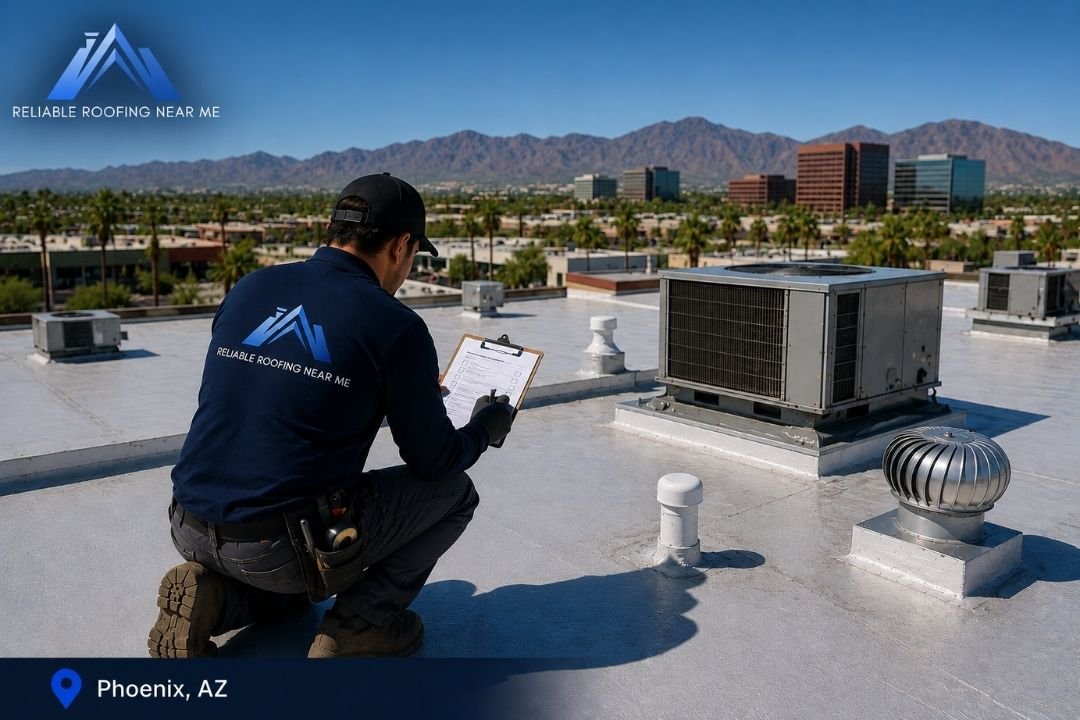
A licensed Mesa roofing contractor inspects the current roof condition — lifting tiles in representative areas to assess underlayment, checking the attic for moisture evidence, evaluating flashing condition at all penetrations and transitions, and assessing attic ventilation adequacy. The outcome is a written, itemized estimate covering all materials, labor, permit costs, and warranty terms. Our Phoenix metro roof inspection checklist outlines everything a thorough inspection should cover.
Step 2 — HOA Approval Where Required
If your Mesa home is in an HOA community, the architectural change request must be submitted and approved before any work begins. This process can take anywhere from five business days to four weeks depending on the HOA’s review schedule. Factor this timeline into your project planning from the start — it is one of the most common sources of delay on Mesa roofing projects and one of the most preventable when planned for appropriately. Our guide on HOA roofing rules in Phoenix Arizona covers the approval process in full detail.
Step 3 — Permit Filing
Your contractor files the required Maricopa County building permit before work begins. The permit must be approved and posted before installation starts. Our guide on Phoenix roof permits covers exactly what is required and what happens when work proceeds without a required permit.
Step 4 — Materials Ordered and Delivered
Roofing materials are ordered per the approved specification — specific product, color, and profile confirmed against HOA requirements where applicable — and delivered to the property. Lead times vary by material and supplier availability. Your contractor advises on realistic material lead times as part of the project scheduling process.
Step 5 — Tear-Off and Deck Inspection
The existing roofing system is removed — tiles carefully stacked for inspection and potential reuse, underlayment stripped, and the deck fully exposed and inspected. This is the stage where deck damage, rotted sections, or structural issues are identified and addressed. Any conditions found during tear-off that affect the project scope and cost should be communicated to you immediately with a clear explanation before additional work proceeds.
Step 6 — Installation
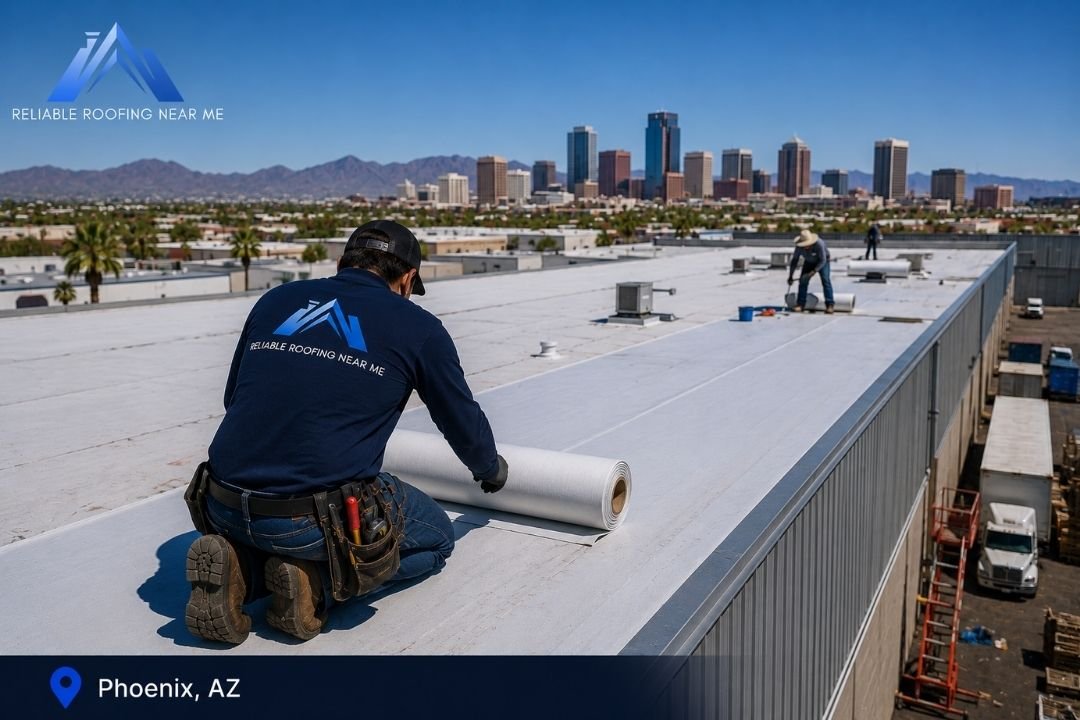
New underlayment is installed per manufacturer specifications with proper overlaps, sealed penetrations, and fully integrated flashing at all edges, valleys, and roof penetrations. Roofing material is installed above the underlayment — tiles relaid from the eave to the ridge, shingles installed per manufacturer nailing patterns, or metal panels installed per system specifications. Ridge caps, hip tiles, and all finishing courses are completed. All flashing sealants are applied at every penetration and transition.
Step 7 — Permit Inspection
A Maricopa County or City of Mesa inspector visits the property to confirm that the completed installation meets code requirements. Your contractor schedules this inspection and is present for it. The permit is closed upon passing inspection — generating the documentation that confirms the work was performed correctly and legally.
Step 8 — Final Walkthrough and Cleanup
Your contractor walks the completed roof with you, confirms all work meets the agreed scope, addresses any questions, and provides all warranty documentation in writing. A full cleanup is performed including a magnetic nail sweep of driveways and lawn areas. All debris is removed from the property.
Most Mesa residential roof replacements take one to three days for asphalt shingles and three to five days for tile or metal roofing. Projects that discover significant deck damage requiring repair extend the timeline accordingly.
Mesa HOA Roofing Requirements
A substantial portion of Mesa’s residential neighborhoods — from Dobson Ranch and Las Sendas to Red Mountain Ranch and Eastmark — operate under HOA governance with specific requirements for roofing materials, colors, profiles, and contractor documentation.
In Mesa’s HOA communities, the most important roofing rule is simple: no work begins without written HOA approval in hand. A homeowner who allows a contractor to begin work before the ARC has issued written approval risks fines, stop-work orders, and in serious cases mandatory removal of non-compliant work at their own expense. The approval process takes time — sometimes weeks for communities whose boards meet monthly — and that timeline must be built into the project schedule from the first planning conversation.
Material restrictions in Mesa HOA communities most commonly require clay or concrete tile in specific profiles and colors. Confirming the approved materials list for your specific community before any contractor ordering occurs is essential. Installing a tile that was not specifically approved — even if it is similar to an approved option — constitutes a violation that requires correction. Our complete guide on HOA roofing rules in Phoenix Arizona covers every aspect of the approval process across Valley HOA communities.
Insurance and Roof Replacement in Mesa AZ
If your Mesa roof was damaged by a covered storm event — monsoon wind, hail, falling debris — your homeowner’s insurance may cover part or all of the replacement cost. Understanding how to navigate the claims process correctly significantly affects the outcome.
The steps that determine whether an insurance-funded replacement proceeds smoothly include documenting damage immediately after the storm event, requesting a professional inspection and written damage assessment from a licensed roofing contractor before contacting your insurer, understanding your policy’s deductible and coverage limits, and working with a contractor experienced in the Arizona insurance claims process.
Our step-by-step guide on the insurance claim process after a Phoenix monsoon covers every stage from documentation to adjuster interaction. Our guide on whether home insurance covers roof replacement in Phoenix clarifies what standard Arizona policies cover and where the common exclusions are.
One critical note: any contractor who offers to waive your insurance deductible as an inducement to hire them is violating Arizona law. Arizona Revised Statutes explicitly prohibit this practice. Walk away from any contractor making this offer and report it to the Arizona Department of Insurance.
Roofing Financing for Mesa Homeowners
A full roof replacement in Mesa is a significant expense that not every homeowner is positioned to fund from cash on hand. Understanding the financing options available — before you need them — gives you the ability to make a sound decision without pressure when the project becomes necessary.
Contractor-arranged financing, personal home improvement loans, home equity loans and HELOCs, and FHA Title I loans are all available to Mesa homeowners depending on their financial profile and project scope. Our complete guide on roofing financing options in Phoenix AZ covers every available option in detail — including the deferred interest terms that catch homeowners off guard and the specific situations where each financing type makes the most sense.
Choosing the Right Roofing Contractor for Replacement in Mesa AZ
The contractor selection decision for a roof replacement in Mesa is one of the most consequential choices in the entire project. The quality of the installation determines whether the new roofing system approaches its rated service life or falls significantly short of it. And the professionalism of the contractor determines whether the warranty documentation, permit records, and HOA approval paperwork are in order — or whether you discover gaps in that documentation at the worst possible moment.
The non-negotiable baseline is an active Arizona ROC license. Verify it at the official Arizona Registrar of Contractors website before any other evaluation proceeds. At Reliable Roofing Near Me, our license number is ROC 355096 — active, in good standing, and verifiable at any time.
Beyond licensing, the evaluation criteria that distinguish genuinely qualified Mesa roofing contractors include current general liability and workers’ compensation insurance certificates provided before work begins, written itemized estimates that specify materials, scope, permit handling, and warranty terms, demonstrated familiarity with Mesa’s HOA communities and their documentation requirements, local references from Mesa homeowners with similar project types, and a clear, knowledgeable answer to any question about attic ventilation, underlayment specification, or the specific material performance characteristics relevant to Mesa’s climate.
Our complete guide on how to choose the best roofing contractor in Phoenix AZ covers the full evaluation framework in detail — giving you the questions and criteria to assess every contractor you consider for your Mesa replacement project.
Frequently Asked Questions
How long does a new roof last in Mesa AZ?
It depends on the material. Clay tile with proper underlayment maintenance lasts 50 to 100 years. Concrete tile lasts 30 to 50 years. Asphalt shingles last 15 to 25 years in Mesa’s heat. Metal roofing lasts 40 to 70 years. The underlayment beneath tile — the actual waterproofing barrier — needs replacement every 20 to 25 years in Arizona’s attic heat conditions regardless of how long the tile itself lasts. Our guide on how long a tile roof lasts in Arizona covers this in full detail.
Do I need a permit for roof replacement in Mesa AZ?
Yes. Full roof replacements in Mesa require a permit through the City of Mesa Development Services Department or Maricopa County depending on your specific address. A licensed roofing contractor handles permit filing as standard practice before work begins. Never allow a contractor to begin a full replacement without a pulled permit — unpermitted work creates serious complications at the point of property sale.
What is the best time of year to replace a roof in Mesa AZ?
The optimal windows for Mesa roof replacement are late winter through spring — February through April — and fall — October through November. These periods offer cooler working temperatures that are safer for installation crews and better for material adhesion, and they fall outside the peak monsoon season when scheduling delays and mid-project storm exposure risk are highest. If your roof is actively leaking or damaged, replacement should not wait for an optimal season — addressing active water intrusion promptly is always the right call regardless of timing.
Can I stay in my home during roof replacement in Mesa AZ?
Yes — in most cases. Roof replacement is noisy and creates temporary disruption, but it does not typically require residents to vacate the property. The exception is when significant deck damage is discovered that requires structural repair work that creates temporary opening of the roof to the elements — in which case your contractor advises on appropriate precautions for the duration of that specific phase.
How do I know if my Mesa roof needs replacement or just repair?
The key indicators that replacement rather than repair is the appropriate scope include a roof more than 20 years old with no documented underlayment replacement, recurring leaks that previous repairs have not resolved, moisture or structural damage visible in the attic, widespread tile or surface deterioration, and deck damage discovered during inspection. Our guide on Phoenix roof replacement vs repair walks through the complete decision framework.
What voids a roof warranty after replacement in Mesa AZ?
Common warranty-voiding actions include unauthorized roof penetrations by other trades, repairs using non-approved materials, pressure washing, improper foot traffic causing tile damage, inadequate attic ventilation, and failure to register the warranty within the required timeframe after installation. Our guide on what voids roof warranty in Arizona covers every exclusion in detail so you can protect your coverage from day one.
Schedule Your Free Roof Replacement Estimate in Mesa AZ
At Reliable Roofing Near Me, we serve Mesa homeowners with licensed, professional, fully documented roof replacement services across every neighborhood in the city — from Dobson Ranch and Red Mountain Ranch to Eastmark, Lehi, and every community in between. We inspect honestly, estimate transparently, install correctly, and stand behind our work with written warranty terms that mean something.
Whether you are facing an overdue underlayment replacement, a full material replacement, storm damage requiring insurance coordination, or simply want to know where your roof stands before committing to anything, we will give you a straight answer and a written estimate with no pressure and no obligation.
Call us at (480) 867-9986 or visit reliableroofingnearme.com to schedule your free Mesa roof inspection today. We serve Mesa, Chandler, Gilbert, Scottsdale, Phoenix, Tempe, Glendale, Peoria, Surprise, and every community across the Valley.
Reliable Roofing Near Me | (480) 867-9986 | reliableroofingnearme@gmail.com | reliableroofingnearme.com | 12428 N 28th Dr Suite 12430, Phoenix, AZ 85029 | ROC License #355096