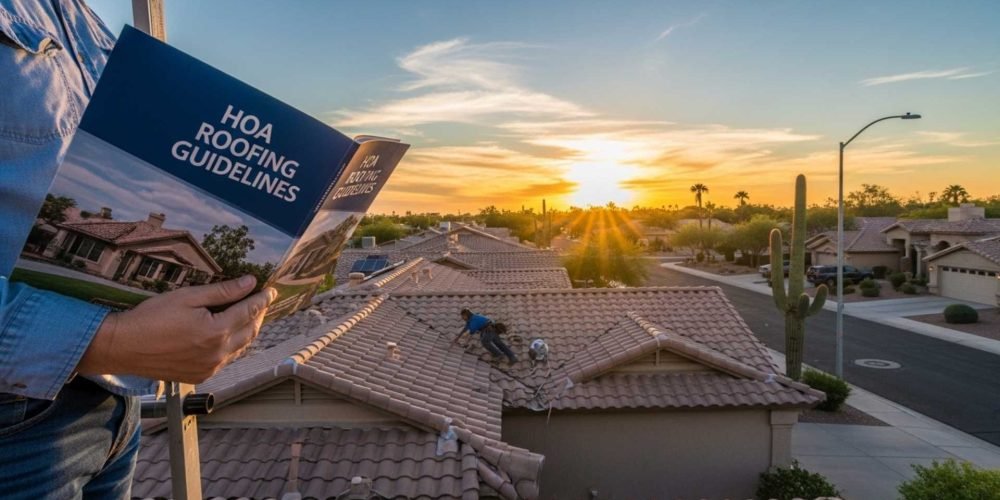
Phoenix and its surrounding cities are home to some of the most active HOA communities in the entire United States. From Scottsdale to Gilbert, Chandler to Peoria, the majority of residential neighborhoods developed in the Valley over the past three decades were built under HOA governance — and roofing is one of the areas where HOA authority is felt most directly by homeowners.
If your home sits in an HOA community in Phoenix, replacing or significantly repairing your roof is not simply a matter of hiring a contractor and scheduling the work. It involves an approval process, material restrictions, color limitations, contractor documentation requirements, and in many cases a timeline that must be respected before a single shingle or tile is removed. Skipping or shortcutting any part of that process can result in fines, mandatory removal of non-approved materials at your expense, and ongoing compliance disputes that complicate your ownership and your ability to sell.
Understanding HOA roofing rules in Phoenix Arizona — what the typical requirements look like, how the approval process works, and how to navigate it efficiently — is essential knowledge for any Valley homeowner with a roof project on the horizon.
Why Phoenix HOAs Take Roofing So Seriously
Roofing is one of the most visible exterior characteristics of any home. In a planned community where aesthetic consistency is a core value protected by the HOA’s Covenants, Conditions, and Restrictions — commonly called CC&Rs — the roofing material, color, and profile visible from the street matters enormously to the organization’s mandate.
Phoenix HOAs also take roofing seriously because of the sheer volume of roofing activity in the Valley. Arizona’s desert climate accelerates roofing material aging, which means roof replacements and major repairs happen more frequently here than in most markets. An HOA that did not actively regulate roofing would quickly see visual inconsistency develop across a community as homeowners made individual material and color choices driven by cost or contractor availability rather than community standards.
The result is that Phoenix and East Valley HOAs — particularly those in master-planned communities — have among the most detailed and actively enforced roofing requirements of any residential communities in the country. Understanding exactly what your specific HOA requires before starting any roofing project is not optional — it is the first step.
The HOA Documents That Govern Roofing in Phoenix
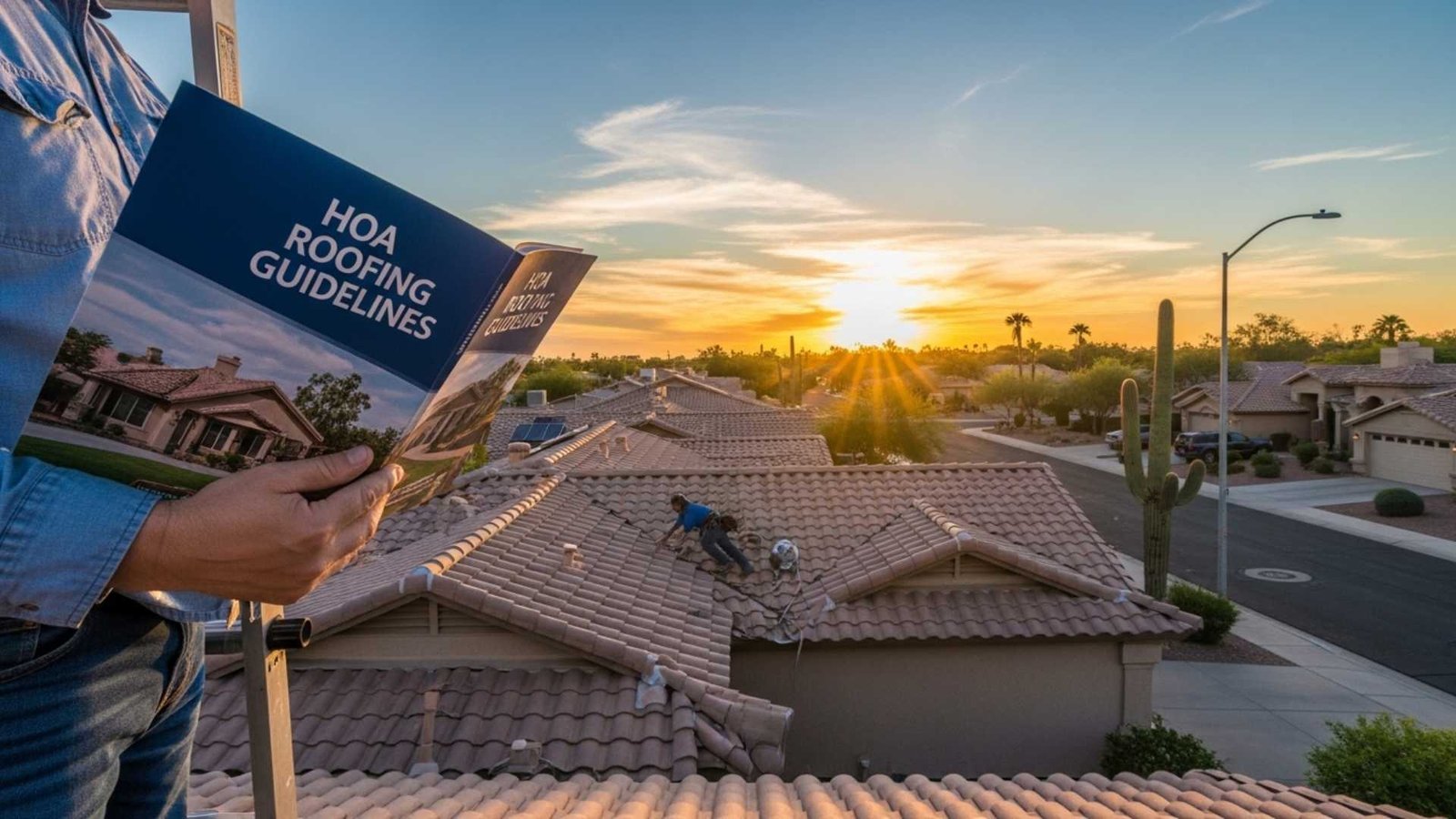
HOA roofing rules in Phoenix Arizona are not uniform. Every HOA operates under its own governing documents, and the specific requirements vary considerably from one community to the next. Before any roofing project, the starting point is reviewing the relevant documents for your specific HOA.
CC&Rs (Covenants, Conditions, and Restrictions)
The CC&Rs are the foundational governing document of any HOA community. They establish the broad rules that all property owners agree to when purchasing in the community — including requirements related to exterior modifications, aesthetic standards, and maintenance obligations. For roofing specifically, CC&Rs typically address which material categories are permitted, what standards apply to roofing work, and what consequences apply for non-compliance.
CC&Rs are recorded with the county at the time the community is established and are legally binding on all property owners regardless of whether they have personally read them. Not knowing what your CC&Rs say about roofing does not exempt you from compliance.
Architectural Guidelines
Most Phoenix HOAs have a separate architectural guidelines document — sometimes called design guidelines or community standards — that provides more specific detail than the CC&Rs. This is typically where you will find the approved roofing material list, the approved color palette, specific profile requirements, and the detailed process for submitting an architectural change request for roofing work.
Architectural guidelines are updated more frequently than CC&Rs and should be obtained in their current version directly from the HOA management company or board — not from a copy provided by a previous owner or your real estate agent, which may be outdated.
Architectural Review Committee (ARC) Requirements
Most Phoenix HOAs have an Architectural Review Committee — sometimes called an Architectural Control Committee or ACC — that reviews and approves exterior modification requests before work begins. The ARC operates under the CC&Rs and architectural guidelines, applying the community’s standards to specific homeowner requests.
The ARC is the body you submit your roofing approval request to, and its decision — approval, conditional approval, or denial — determines whether your project can legally proceed. Understanding how your specific HOA’s ARC operates, what documentation it requires, and what its typical review timeline looks like is essential planning information for any Phoenix roofing project.
What Phoenix HOA Roofing Rules Typically Cover
While every HOA is different, Phoenix and East Valley HOA roofing requirements cluster around several consistent categories. Here is what most active HOA communities in the Valley regulate regarding roofing.
Approved Roofing Materials
Material approval is the most fundamental roofing requirement in most Phoenix HOAs. The approved materials list specifies which roofing products are permitted in the community — typically by material category and sometimes by specific product lines or manufacturers.
In Phoenix’s established neighborhoods and master-planned communities, clay or concrete tile is almost universally required or strongly preferred. Many communities that were built with tile roofs explicitly prohibit replacement with other material categories — meaning a homeowner who wants to replace their tile roof with a metal or asphalt shingle system cannot do so under HOA rules regardless of personal preference or budget considerations.
Communities that permit multiple material categories typically specify which are allowed and under what conditions. Asphalt shingles, where permitted, are often restricted to specific architectural grades. Metal roofing is increasingly being added to approved lists in newer communities but remains excluded in many established HOAs whose governing documents predate metal roofing’s rise in the Phoenix market.
If you are considering a material change on your roof — for example switching from concrete tile to clay tile, or from asphalt to metal — confirming material approval with your HOA before any other planning is the essential first step. Read our comparison of concrete tile vs clay tile roof in Arizona to understand the material options that are most commonly approved across Phoenix HOA communities.
Approved Colors and Profiles
Material category approval is only the beginning. Most Phoenix HOAs also specify approved colors — sometimes down to specific manufacturer color codes — and approved tile profiles for communities where tile is the required material.
Color restrictions exist because a community where homeowners freely chose their own tile colors would rapidly lose the visual cohesion that HOAs are designed to maintain. Approved color palettes in Phoenix HOA communities typically reflect the earth tones, terracotta ranges, and desert neutrals that characterize the region’s architectural tradition.
Profile restrictions — specifying whether barrel tile, flat tile, or other profiles are permitted — similarly protect the architectural character of the community. A neighborhood established with high-profile barrel tile roofs has a specific visual character that would be disrupted by a homeowner installing flat tile on a neighboring property.
The practical implication: Before purchasing materials or allowing a contractor to order anything, confirm both the color and profile specifications with your HOA. Do not rely on a contractor’s assurance that a particular tile will be approved — get that confirmation in writing from the HOA or its management company.
Contractor Documentation Requirements
Many Phoenix HOA communities require proof that the roofing contractor performing the work is licensed and insured before approving a project. This requirement protects the community from the liability and quality risks associated with unlicensed or underinsured contractors performing work within the development.
Documentation typically required includes the contractor’s Arizona ROC license number and certificate, proof of general liability insurance at specified minimum coverage levels, and proof of workers’ compensation coverage.
A legitimate, licensed Phoenix roofing contractor should provide all of this documentation without hesitation. At Reliable Roofing Near Me, our Arizona ROC license number is ROC 355096 — verifiable at any time through the official Arizona Registrar of Contractors. We routinely prepare the full documentation package that Phoenix HOA communities require as a standard part of our project process. You can learn more about what to look for in a licensed Arizona roofing contractor before selecting one for your HOA project.
Permit Requirements
HOA approval and city or county building permits are two separate requirements that must both be satisfied for a roofing project in Phoenix. HOA approval does not substitute for a building permit, and a building permit does not substitute for HOA approval.
In Phoenix and throughout Maricopa County, a permit is required for full roof replacements and most significant roofing work. The permit must be filed and approved before work begins — not after. A licensed roofing contractor handles permit filing on your behalf as a standard part of the project process.
Our detailed guide on Phoenix roof permits covers exactly which projects require permits, what the filing process involves, and what happens when work is performed without a required permit. Understanding both the HOA approval and the permit requirement — and ensuring both are properly satisfied before work begins — protects you from the complications that arise when either is bypassed.
Timing and Scheduling Restrictions
Some Phoenix HOA communities place restrictions on the hours and days during which construction activity — including roofing work — may occur within the development. These restrictions typically limit early morning starts, weekend work, and in some cases limit the total duration of a roofing project.
Your roofing contractor needs to be aware of any such restrictions before scheduling your project. A contractor who begins work at 6:00 AM in a community that prohibits construction before 7:00 AM is generating a complaint and potentially a fine for you as the homeowner — even though the contractor is the one who made the scheduling decision.
Confirm scheduling restrictions with your HOA management company and communicate them explicitly to your contractor before the project start date is set.
The HOA Approval Process for Roofing in Phoenix: Step by Step
Understanding the approval process from end to end — before you start it — allows you to plan your project timeline realistically and avoid the frustration of unexpected delays.
Step 1 — Review Your Governing Documents
Obtain the current version of your HOA’s CC&Rs and architectural guidelines. Review the roofing sections carefully, noting the approved materials, colors, profiles, and any specific requirements for the approval submission. If anything is unclear, contact the HOA management company for clarification in writing — not by phone, so you have a documented record of the guidance received.
Step 2 — Select a Licensed Contractor and Confirm Material Compliance
Choose your roofing contractor and have them confirm in writing that the proposed materials — specific tile product, color, and profile — comply with your HOA’s requirements. A contractor experienced with Phoenix HOA projects will be familiar with the documentation requirements of most major Valley HOA management companies and can often advise on which products are most commonly approved in communities like yours.
Step 3 — Prepare and Submit the Architectural Change Request
Most Phoenix HOAs require a formal Architectural Change Request — sometimes called an ARC application or ACC application — to be submitted and approved before any exterior modification work begins. The application typically includes a description of the proposed work, the specific materials to be used including manufacturer, product name, and color code, a sample or photograph of the proposed tile or material, the contractor’s license and insurance documentation, and in some cases a site plan or diagram showing the affected roof areas.
Submit the complete application to the HOA management company or ARC directly. Incomplete submissions are the most common cause of delays — missing a single required document typically sends the application back to the start of the review queue.
Step 4 — Wait for ARC Review and Decision
Phoenix HOA ARC review timelines vary considerably by community. Some HOAs with active management companies turn around approvals within 5 to 10 business days. Others with boards that meet monthly may take 3 to 4 weeks to render a decision. A few larger master-planned communities have expedited review processes for standard roofing replacements using pre-approved materials.
Factor the review timeline into your project schedule from the beginning. A homeowner who contacts a roofing contractor in June expecting work to begin within two weeks, without having initiated the HOA approval process, may find themselves waiting through July’s peak monsoon season before approval arrives and the project can begin.
If your roofing situation involves active water intrusion — a failed underlayment causing interior leaks during monsoon storms — communicate the urgency to your HOA management company in writing. Many HOAs have an emergency provision allowing temporary protective measures while the full approval process proceeds for the permanent work.
Step 5 — Proceed With Permitted and Approved Work
Once HOA approval is in hand and the building permit has been filed and approved, work can begin. Keep copies of both the HOA approval letter and the permit on file. Some HOA communities require that the approval documentation be available on site during the project — confirm this requirement with your management company.
Step 6 — Final Inspection and HOA Notification
After the project is complete, some Phoenix HOAs require notification or a final inspection to confirm that the completed work matches the approved application. Your contractor should be aware of any such requirement and support the completion of this step.
The city or county building inspector’s sign-off on the permit — which occurs as part of the standard permit process — is separate from any HOA inspection and must also be completed before the permit is closed.
Common HOA Roofing Violations in Phoenix and How to Avoid Them
HOA roofing violations in Phoenix fall into a predictable set of categories. Understanding what trips homeowners up most often helps you avoid the same outcomes.
Starting work before approval is received. This is the most common and most costly violation. A homeowner who allows a contractor to begin work before the ARC has issued written approval — even if approval seems likely — faces potential fines, stop-work orders, and in serious cases mandatory removal of non-compliant work at their own expense. Never allow roofing work to begin without written HOA approval in hand.
Installing materials that were not what was approved. An approval for a specific tile product, color, and profile is an approval for exactly that — not for a similar product that the contractor substituted when the specified product was backordered. Any material change after approval requires a new or amended application. If your contractor proposes a substitution, halt the project and seek a modified approval before allowing installation to proceed.
Using a contractor whose documentation does not meet HOA requirements. Discovering after approval that your contractor’s insurance coverage is below the minimum required by your HOA — or that their license documentation was not what the HOA required — delays the project and creates a compliance gap. Confirm contractor documentation requirements with your HOA before selecting a contractor, not after.
Missing the permit requirement entirely. Some Phoenix homeowners — and some contractors — proceed with roofing work under HOA approval without filing the required city or county building permit, believing that HOA approval is sufficient. It is not. Unpermitted roofing work creates complications at the point of sale and may create liability issues if a future claim arises in connection with the roof. Confirm permit requirements with both your HOA and your contractor before work begins. Our guide on Phoenix roof permits covers this in full detail.
Failing to maintain the approved roof after installation. HOA compliance does not end when the new roof is installed. Ongoing maintenance obligations — keeping the roof in good condition, replacing cracked or missing tiles promptly, maintaining gutters and drainage systems — are typically part of the CC&Rs. A roof that falls into visible disrepair can generate HOA compliance action even if it was properly approved and installed. Our Phoenix metro roof maintenance checklist outlines the regular maintenance tasks that keep a Phoenix roof in HOA-compliant condition.
HOA Roofing Rules and Roof Replacement Cost in Phoenix
HOA requirements have a direct impact on the cost of roof replacement in Phoenix HOA communities — and understanding that impact helps you budget accurately from the beginning.
Material restrictions that require clay or concrete tile rather than less expensive alternatives establish a cost floor that homeowners cannot work around. A homeowner who might otherwise choose a $10,000 asphalt shingle replacement for budget reasons may find that their HOA’s tile requirement puts the minimum compliant project at $18,000 or above.
Color and profile restrictions similarly limit the ability to optimize for cost by choosing the least expensive available product — if the least expensive option does not match the HOA’s approved palette, it is not a viable option regardless of price.
For a full understanding of what compliant materials cost in the current Phoenix market, our guide on roof replacement cost in Phoenix metro provides detailed pricing by material type. And if you are weighing whether repair or full replacement is the appropriate scope for your situation — a decision that also has HOA implications — our guide on Phoenix roof replacement vs repair walks through the factors that determine the right call.
Working With a Roofing Contractor Who Understands Phoenix HOAs
Not all Phoenix roofing contractors have equal experience navigating HOA requirements. A contractor who primarily works on non-HOA properties may be unfamiliar with the specific documentation, application format, and communication protocols that Phoenix HOA management companies require — creating delays and complications that an experienced contractor would have avoided.
When selecting a roofing contractor for an HOA project in Phoenix, the relevant questions to ask include whether they have completed roofing projects within HOA communities in your area, whether they are familiar with the documentation requirements of your specific HOA management company, whether they will prepare and submit the ARC application on your behalf or assist you in doing so, and whether they carry license and insurance documentation in the format most Phoenix HOAs require.
Our guide on how to choose the best roofing contractor in Phoenix AZ covers the full evaluation framework for selecting a contractor — including the HOA experience and documentation factors that matter specifically in Phoenix’s HOA-heavy market.
Frequently Asked Questions
Can my HOA force me to replace my roof in Phoenix?
Yes — in specific circumstances. Most Phoenix HOA CC&Rs include provisions that require homeowners to maintain their roofs in good condition and replace them when they have deteriorated to a point that affects the community’s appearance or creates a nuisance. An HOA that determines a roof has reached that threshold can issue a compliance notice requiring replacement within a specified timeframe. Ignoring the notice typically results in escalating fines and, in some cases, the HOA pursuing legal remedies to compel compliance.
What happens if I replace my roof without HOA approval in Phoenix?
The consequences range from fines to mandatory removal of the non-approved work at your expense. Most Phoenix HOAs have escalating fine structures for unapproved exterior modifications. In cases where non-approved materials were installed — particularly when they do not match the community’s approved materials list — the HOA can require removal and replacement with compliant materials, with all costs borne by the homeowner. This outcome — paying for a roof twice — is the most expensive possible result of bypassing the approval process.
How long does HOA roof approval take in Phoenix?
It varies significantly by HOA. Communities with professional management companies and active ARC processes can turn around approvals in 5 to 10 business days for standard replacement projects using pre-approved materials. Communities where the board meets monthly may take 3 to 4 weeks. Planning for a minimum of 2 to 3 weeks between application submission and approval — and potentially longer — is prudent for any Phoenix roofing project in an HOA community.
Does my HOA have to approve a like-for-like roof replacement in Phoenix?
It depends on the HOA’s governing documents. Some Phoenix HOAs have streamlined or pre-approved processes for like-for-like replacements — same material, same color, same profile as what existed before. Others require a full ARC application regardless of whether the replacement matches the original. Confirming the process for your specific HOA before assuming a like-for-like replacement is pre-approved avoids the costly mistake of proceeding without required authorization.
Can I appeal an HOA roofing denial in Phoenix?
Yes. Most Phoenix HOA CC&Rs include an appeal process for adverse ARC decisions. The appeal is typically heard by the full HOA board rather than the ARC alone. Grounds for appeal generally include demonstrating that the denial was inconsistent with the CC&Rs, that the architectural guidelines were applied incorrectly, or that the proposed materials meet the spirit and intent of the community standards even if they do not match a specific listed product. Consulting with an Arizona HOA attorney before filing an appeal is advisable for significant disputes.
Schedule Your Roofing Project in Phoenix With HOA Experience
At Reliable Roofing Near Me, we have extensive experience completing roofing projects across Phoenix and the East Valley’s HOA communities. We prepare the documentation your HOA requires, assist with the ARC application process, use materials from the approved product lines most commonly accepted across the Valley’s major communities, and coordinate the permit process — so your project moves forward without the delays that come from HOA process mistakes.
Call us at (480) 867-9986 or visit reliableroofingnearme.com to schedule your free roof inspection and estimate today. We serve Phoenix, Scottsdale, Mesa, Chandler, Gilbert, Glendale, Peoria, Tempe, Surprise, and every community across the Valley.
Reliable Roofing Near Me | (480) 867-9986 | reliableroofingnearme@gmail.com | reliableroofingnearme.com | 12428 N 28th Dr Suite 12430, Phoenix, AZ 85029 | ROC License #355096