Most Phoenix homeowners think about their roof in terms of what they can see — the tiles, the shingles, the flat membrane on top. What very few think about is what is happening inside the roof assembly, in the space between the roofing material above and the insulation below. And in Phoenix’s climate, what happens in that space has a direct and significant impact on your energy bills, your roof’s lifespan, and the structural integrity of your home.
Roof ventilation is the system that manages heat and moisture movement through that space. In moderate climates it is a standard building requirement that performs its function quietly and without much consequence if it is slightly inadequate. In Phoenix, where attic temperatures regularly reach 150 to 160 degrees Fahrenheit during summer, inadequate roof ventilation is not a minor efficiency issue — it is an active and accelerating source of damage to your roofing system, your insulation, and your home’s structural framing.
Understanding roof ventilation in Phoenix AZ — how it works, why it matters more here than almost anywhere else in the country, and what to do if your home’s ventilation is inadequate — is one of the most valuable things a Valley homeowner can know.
What Roof Ventilation Actually Does
Roof ventilation is a system of intake and exhaust points that allows outside air to flow continuously through the attic or roof assembly, replacing the superheated air that accumulates there with cooler air from outside.
The system works on a straightforward principle. Cooler outside air enters the roof assembly through intake vents — typically located at the soffits along the eaves of the roof. As that air heats up inside the attic space, it rises naturally and exits through exhaust vents at or near the roof ridge. This continuous airflow — driven by both thermal buoyancy and wind pressure — prevents heat from accumulating to destructive levels inside the roof assembly.
A properly ventilated roof maintains this continuous airflow throughout the day and night. An inadequately ventilated roof traps heat inside the assembly with nowhere to escape, allowing temperatures to climb to extremes that damage everything they contact.
There are two components that must both be present and correctly sized for ventilation to function properly:
Intake ventilation brings outside air into the roof assembly at the lowest point — typically soffit vents running along the eave line of the roof. Without adequate intake, exhaust vents cannot draw air through the assembly effectively regardless of how many exhaust points exist.
Exhaust ventilation allows heated air to escape from the highest point of the roof assembly — typically ridge vents running along the peak of the roof, box vents positioned near the ridge, or powered attic fans. Without adequate exhaust, intake air has nowhere to go and the ventilation system stalls.
Both components must be balanced and correctly sized relative to the attic floor area they serve. An imbalanced system — too much exhaust and too little intake, or vice versa — underperforms significantly compared to a properly balanced installation.
Why Roof Ventilation Matters More in Phoenix Than Almost Anywhere Else
The physics of roof ventilation are the same everywhere. What makes Phoenix different is the scale of the problem that inadequate ventilation creates.
In a city with moderate summer temperatures, attic heat accumulation is an efficiency issue that raises cooling costs somewhat and modestly accelerates roofing material aging. The consequences are real but measured.
In Phoenix, the consequences are in a different category entirely.
Attic temperatures in Phoenix without adequate ventilation regularly reach 150 to 165 degrees Fahrenheit during peak summer afternoons. At those temperatures, the damage to every component of the roof assembly is not gradual — it is rapid, cumulative, and expensive.
What Extreme Attic Heat Does to Your Roof
Accelerated underlayment degradation: The waterproof membrane beneath your tiles or shingles is the most heat-sensitive critical component in your roof assembly. Sustained temperatures above 140 degrees Fahrenheit accelerate the breakdown of the bitumen and polymer compounds that give underlayment its flexibility and waterproofing properties. An inadequately ventilated Phoenix attic can cut underlayment service life significantly — turning a 25-year product into a 15-year one, or less.
Premature shingle failure: Asphalt shingles are designed to handle heat — but they are not designed to handle the sustained 160-degree temperatures that an unventilated Phoenix attic generates. At those temperatures, the oils that keep shingles flexible cook out of the material, leaving shingles brittle, prone to cracking, and incapable of maintaining their seal tabs. Shingles on inadequately ventilated Phoenix roofs routinely fail years ahead of schedule.
Roof deck deterioration: The plywood or OSB decking that forms the structural base of your roof is affected by sustained extreme heat. Over years, the adhesives that bond plywood veneers break down, causing delamination. Decking that has delaminated loses its structural integrity and must be replaced — a significant additional cost when it is discovered during a roofing project.
Thermal cycling amplification: Poor ventilation amplifies the already-significant thermal cycling that Phoenix roofs experience from daily temperature swings. When the attic retains extreme heat through the afternoon and the temperature drops sharply at night, the differential stress on every fastener, seam, and joint in the roofing system is greater than it would be with proper ventilation moderating the temperature peaks.
What Extreme Attic Heat Does to Your Home
Dramatically increased cooling costs: The most immediately felt consequence of poor roof ventilation in Phoenix is its impact on your air conditioning system. When your attic is 160 degrees, that heat radiates downward through your ceiling insulation and into your living space continuously. Your air conditioning system works harder, runs longer, and consumes significantly more energy to overcome that radiant heat load. Properly ventilating an attic in Phoenix can reduce cooling costs by 10 to 20 percent in many cases — a meaningful annual saving in a city with Phoenix’s summer electricity rates.
Insulation performance degradation: Attic insulation is rated for its thermal resistance at standard temperatures. When insulation is continuously exposed to extreme heat from above, its effective performance is reduced below its rated value. In a poorly ventilated Phoenix attic, you may have the correct depth of insulation installed and still be getting significantly less thermal protection than you are paying for.
HVAC equipment stress: Most Phoenix homes have HVAC equipment — air handlers, ductwork — running through the attic space. Equipment and ductwork operating in a 160-degree environment is under significantly more stress than the same equipment in a properly ventilated 120-degree attic. This stress reduces equipment lifespan and increases maintenance frequency.
Signs Your Phoenix Roof Has Inadequate Ventilation
Several clear indicators suggest that a Phoenix home’s roof ventilation is insufficient or malfunctioning.
High Cooling Bills That Don’t Match Your Insulation Level
If your energy bills during Phoenix summers are significantly higher than neighbors with comparable homes, and your insulation is at the recommended depth, inadequate roof ventilation is a primary suspect. The radiant heat load from an overheated attic overwhelms insulation performance and forces your air conditioning system to compensate continuously.
Excessive Heat on Upper Floor Ceilings
If the ceiling on your home’s top floor feels noticeably warm to the touch during afternoon hours, heat is radiating downward from an attic that is not being adequately cooled by airflow. This is one of the most direct physical signs of ventilation inadequacy.
Roofing Materials Aging Faster Than Expected
If your shingles are showing granule loss, cracking, or brittleness significantly ahead of their expected service life, or if your tile underlayment has needed replacement earlier than the 20 to 25-year Arizona average, inadequate ventilation is a likely contributing factor. Have your attic ventilation assessed before replacing roofing materials — otherwise the same conditions will shorten the lifespan of whatever you install next.
Visible Damage to Roof Decking or Rafters
During any roofing project that exposes the deck, delaminated plywood, darkened rafters, or any evidence of moisture damage in an otherwise dry attic indicates thermal and potentially moisture-related stress from poor ventilation. This warrants a full ventilation assessment before the new roofing system is installed above it.
No Visible Soffit Vents or Ridge Vents
A simple visual inspection of your home’s exterior can reveal obvious ventilation deficiencies. If you walk around your home and see no soffit vents along the eaves — or if existing vents are blocked by accumulated insulation, paint, or debris — your intake ventilation is compromised regardless of what exhaust vents exist above. Similarly, the absence of a continuous ridge vent or box vents near the ridge peak is a clear indicator of inadequate exhaust capacity.
Ice Dams — Rare in Phoenix But Not Impossible
In the few Arizona locations that experience freezing temperatures — higher elevation communities, northern Arizona — ice dams form when attic heat melts snow on the roof surface and the meltwater refreezes at the cold eaves. While this is not a Phoenix metro concern, it is worth noting for Reliable Roofing Near Me customers in higher-elevation service areas.
Types of Roof Ventilation Used in Phoenix
Several ventilation system types are used across Phoenix residential roofing, each with different performance characteristics and cost profiles.
Ridge Vents
Ridge vents run continuously along the peak of the roof ridge, providing exhaust ventilation across the full length of the roof. They are the most effective exhaust ventilation solution for most Phoenix residential roofs because they allow heated air to escape at the highest point of the attic from every section of the roof simultaneously.
Modern baffled ridge vents prevent weather infiltration while allowing maximum airflow. They are low-profile and nearly invisible from the street. Ridge vents paired with adequate soffit intake ventilation represent the most effective passive ventilation system for Phoenix homes.
Soffit Vents
Soffit vents are the intake component of the ventilation system, installed in the underside of the roof overhang along the eaves. They allow outside air to enter the attic at the lowest point, creating the airflow path that draws heat upward and out through the exhaust vents above.
Continuous soffit vents — running the full length of the eave — provide more uniform intake than individual round or rectangular vents spaced at intervals. In Phoenix, where intake is frequently the limiting factor in ventilation performance, continuous soffit venting is the preferred specification.
A common problem in existing Phoenix homes is soffit vents that have been blocked by insulation pushed to the eaves during installation. Baffles installed between rafters at the eave keep the intake pathway open regardless of insulation depth.
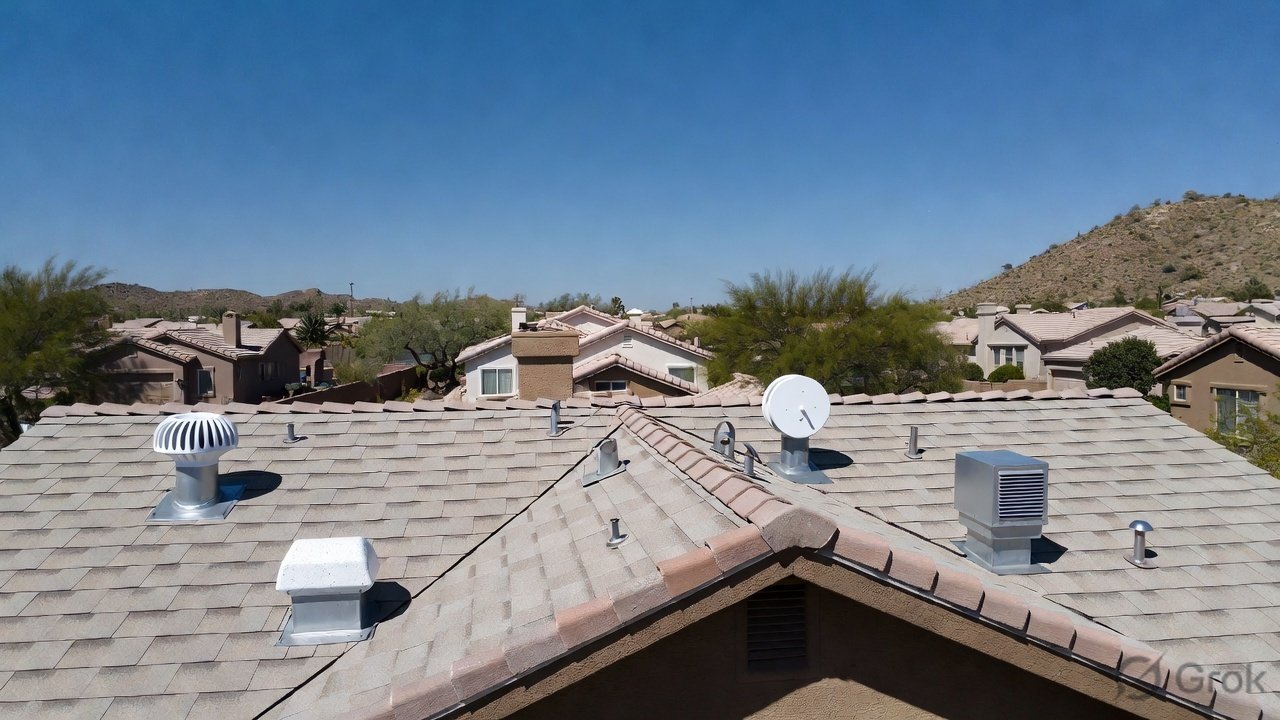
Box Vents and Static Vents
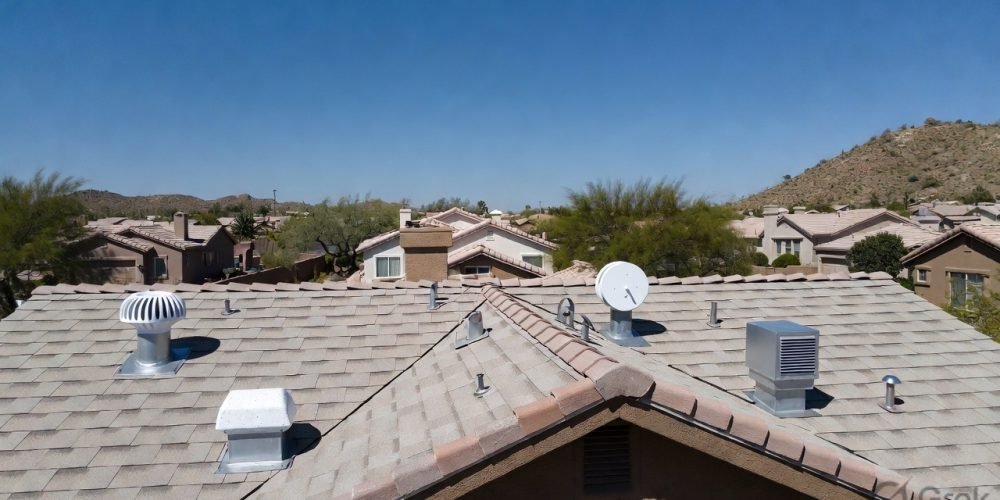
Box vents — also called static vents or turtle vents — are individual exhaust units installed through the roof surface near the ridge. They are less effective per unit than continuous ridge vents but are a practical solution for roof geometries where a continuous ridge vent is not feasible.
Multiple box vents distributed across the upper roof surface can provide adequate exhaust capacity when sized and positioned correctly relative to the attic floor area they serve.
Powered Attic Fans
Powered attic fans — thermostat-controlled electric fans that activate when attic temperatures reach a set threshold — actively draw heat out of the attic rather than relying on passive airflow. They are effective at reducing peak attic temperatures and are sometimes the right solution for Phoenix homes where passive ventilation alone cannot achieve adequate airflow due to roof geometry or construction constraints.
The main consideration with powered fans is ensuring that the intake ventilation is adequate to supply the air volume the fan moves. A powerful exhaust fan drawing against inadequate intake will depressurize the attic and pull conditioned air from the living space below — increasing rather than decreasing cooling costs.
Solar-powered attic fans eliminate the operating cost concern by running entirely on solar energy — a practical and cost-effective option in Phoenix’s sun-drenched climate.
Turbine Vents
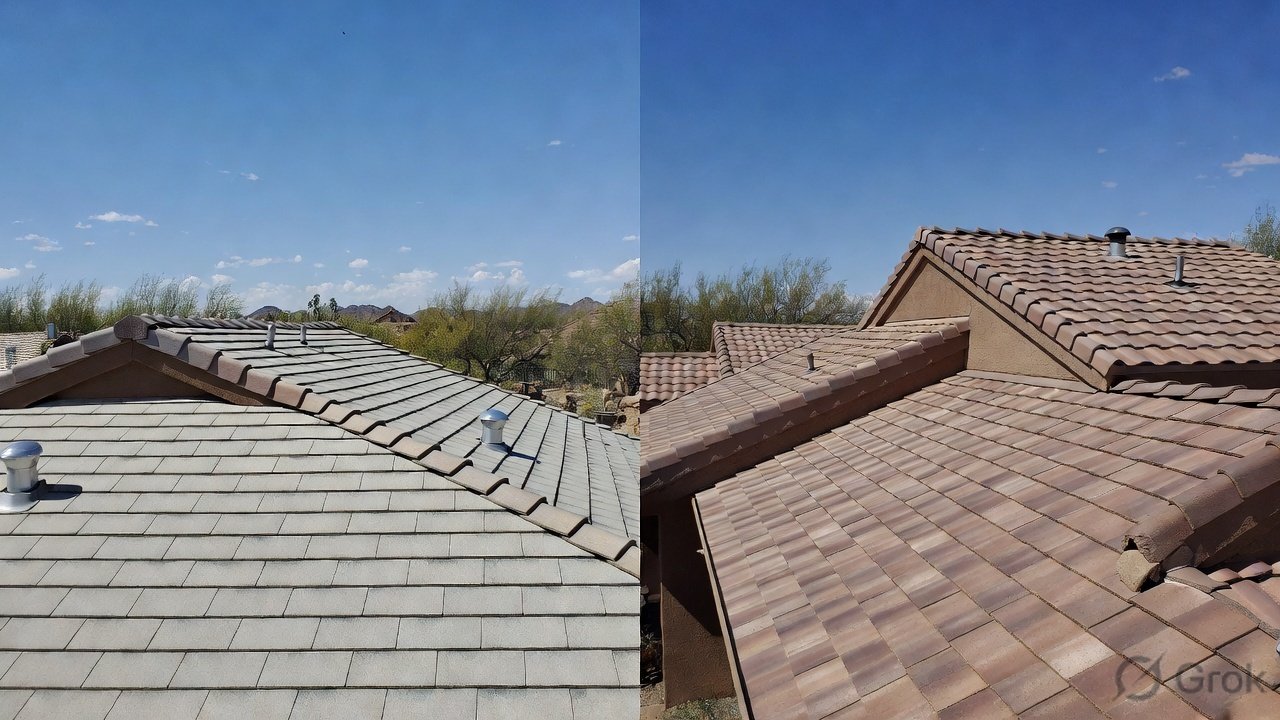
Turbine vents — the spinning metal ventilators visible on many older Phoenix roofs — use wind energy to actively draw air out of the attic. They are effective when wind is present but provide no ventilation benefit on calm days. In Phoenix, where wind is inconsistent, turbine vents are a secondary solution rather than a primary ventilation strategy. Many older Phoenix homes have turbines installed as the sole exhaust ventilation — a setup that is typically inadequate for Phoenix’s attic heat levels.
Roof Ventilation Requirements in Phoenix
The standard ventilation ratio required by building codes in Arizona — and nationally — is a minimum of 1 square foot of net free ventilation area for every 150 square feet of attic floor area, split equally between intake and exhaust. This ratio can be reduced to 1:300 when the ventilation is evenly balanced between intake at the eave and exhaust at the ridge.
These are minimum code requirements. In Phoenix’s extreme climate, many experienced contractors recommend exceeding these minimums — particularly on homes with dark roofing materials, limited overhangs, or complex roof geometries that restrict natural airflow.
When a roofing project is permitted in Phoenix or Maricopa County, the ventilation system is subject to inspection. A licensed contractor will confirm that the ventilation specification meets or exceeds code requirements and document it as part of the permit process.
Roof Ventilation Cost in Phoenix AZ
Ventilation improvement costs in Phoenix depend on the type of ventilation being added or corrected, the accessibility of the installation locations, and whether the work is being done as part of a broader roofing project or as a standalone improvement.
Ridge vent installation (per linear foot): $8 to $15 per linear foot installed A 40-foot ridge vent installation on a typical Phoenix home runs approximately $320 to $600 for the ventilation component alone, not including any roofing material disturbance required.
Soffit vent installation (per vent): $15 to $50 per vent Continuous soffit vent installation on a full eave line runs $300 to $800 for most Phoenix homes depending on linear footage and soffit material.
Box vent installation (per unit): $75 to $200 per vent installed Individual box or static vents installed near the ridge cost $75 to $200 per unit including cutting, flashing, and installation.
Solar-powered attic fan installation: $300 to $600 per unit installed Solar attic fans are a cost-effective active ventilation option in Phoenix given the abundant solar resource and zero operating cost after installation.
Full ventilation assessment and upgrade (typical Phoenix home): $500 to $1,500 A complete ventilation improvement — adding or replacing ridge venting, clearing blocked soffits, installing baffles, and adding supplemental exhaust capacity — typically runs $500 to $1,500 for a standard Phoenix residential roof depending on the scope identified during inspection.
These costs are significantly lower than the roofing material and structural damage that inadequate ventilation causes over time. Addressing ventilation deficiencies proactively is one of the highest-return maintenance investments available to Phoenix homeowners.
Frequently Asked Questions
How do I know if my Phoenix roof has enough ventilation?
A professional inspection is the definitive answer. Observable indicators include high cooling bills, warm upper-floor ceilings, premature roofing material aging, and visible absence of soffit or ridge vents. An experienced Phoenix roofing contractor can assess your current ventilation ratio against code requirements and Phoenix-specific performance standards during a roof inspection.
Can I add roof ventilation to an existing Phoenix home?
Yes. Ridge vents, box vents, soffit vents, and powered attic fans can all be added to existing Phoenix homes. The scope and cost depend on the current ventilation configuration and roof construction. Adding ventilation is almost always practical and is one of the most cost-effective roofing improvements available.
Does roof ventilation really reduce my energy bills in Phoenix?
Yes — measurably so. Properly ventilated attics in Phoenix run significantly cooler than inadequately ventilated ones, which directly reduces the radiant heat load on the living space below and the demand on the air conditioning system. Reductions of 10 to 20 percent in cooling costs are realistic for homes upgrading from significantly inadequate ventilation.
Should I cover my roof vents in Phoenix winter?
No. Year-round ventilation is the correct approach in Phoenix. Even in winter, attic moisture management requires continuous airflow. Blocking vents seasonally is not recommended and is unnecessary given Phoenix’s mild winters.
Does adding roof ventilation require a permit in Phoenix?
Minor ventilation work — adding individual vents or clearing blocked soffits — typically does not require a permit. Structural modifications or ventilation work performed as part of a permitted roofing project is included in that permit scope. A licensed contractor will advise on permit requirements for your specific project.
Get Your Roof Ventilation Assessed in Phoenix
At Reliable Roofing Near Me, we assess and improve roof ventilation systems for homes and commercial properties across Phoenix and more than 40 Arizona cities. If your energy bills are higher than they should be, your roofing materials are aging faster than expected, or you simply do not know whether your current ventilation is adequate for Phoenix’s conditions, we can give you a clear, honest answer.
Call us at (480) 867-9986 or visit reliableroofingnearme.com to schedule your free roof inspection today. We serve Phoenix, Scottsdale, Mesa, Chandler, Gilbert, Glendale, Peoria, Tempe, Surprise, and every community across the Valley.
Reliable Roofing Near Me | (480) 867-9986 | reliableroofingnearme@gmail.com | reliableroofingnearme.com | 12428 N 28th Dr Suite 12430, Phoenix, AZ 85029 | ROC License #355096