Most Phoenix homeowners think about roof damage in terms of what they can see from the ground — cracked tiles, missing shingles, visible leaks after a monsoon storm. What almost no one thinks about is the damage happening silently, invisibly, and continuously inside their roof assembly every single summer day.
Attic ventilation and roof heat in Arizona are directly and inseparably connected. The space between your roofing material above and your ceiling insulation below is not a passive void. It is a thermal environment that, in Phoenix’s climate, reaches temperatures most homeowners find genuinely shocking when they first hear the number. And it is an environment that, when poorly managed, systematically destroys every heat-sensitive component in your roof assembly — years or even decades ahead of schedule.
Understanding the relationship between attic ventilation and roof heat in Arizona is one of the most practically valuable things a Valley homeowner can know. It explains why some Phoenix roofs fail at 15 years when they were rated for 25. It explains why energy bills are higher than insulation levels should produce. And it points directly to one of the most cost-effective interventions available for extending roof life and reducing cooling costs across the Valley.
What Actually Happens in a Phoenix Attic During Summer
To understand why attic ventilation matters so much in Arizona specifically, start with the temperature numbers — because they are the foundation of everything that follows.
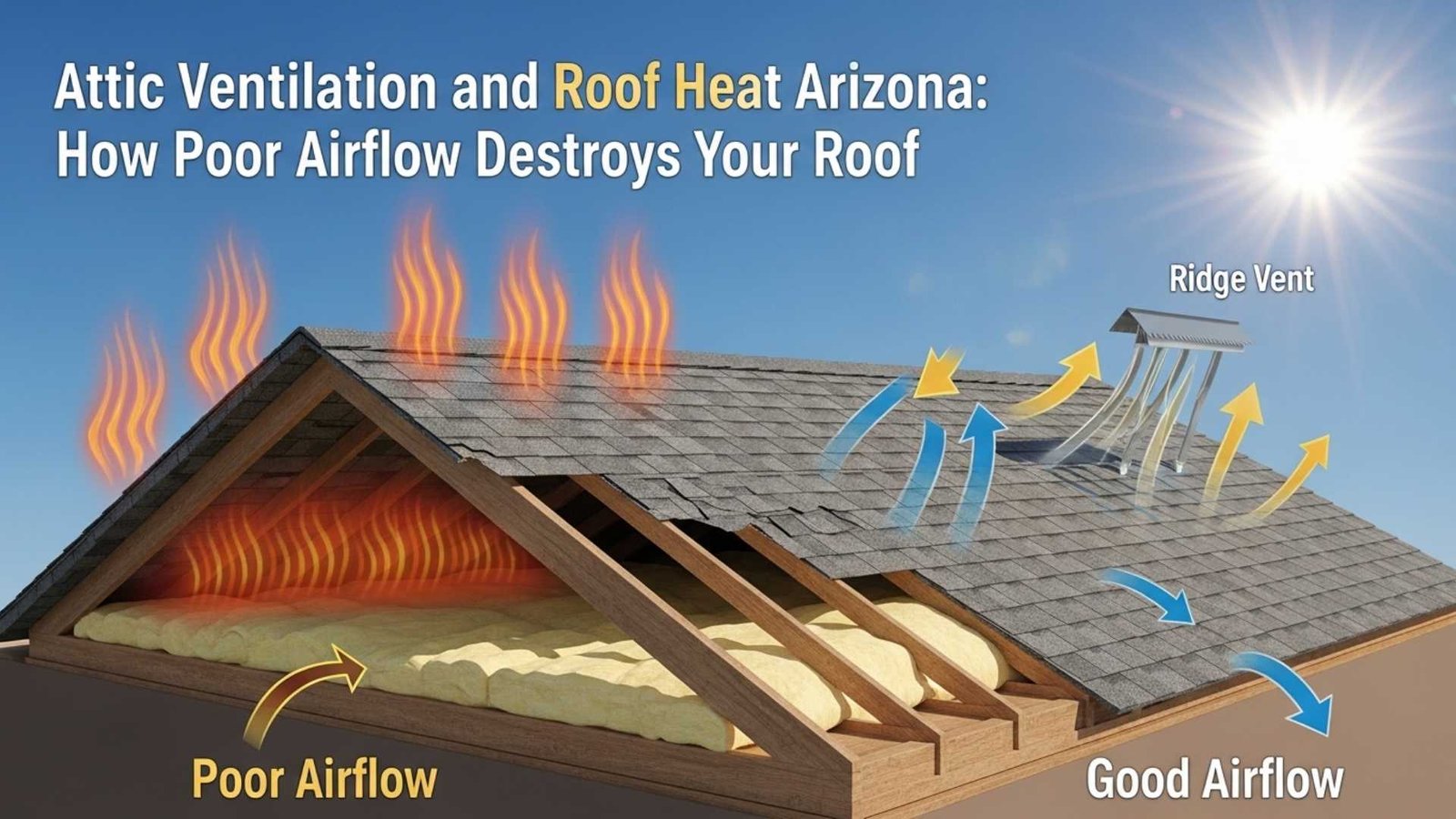
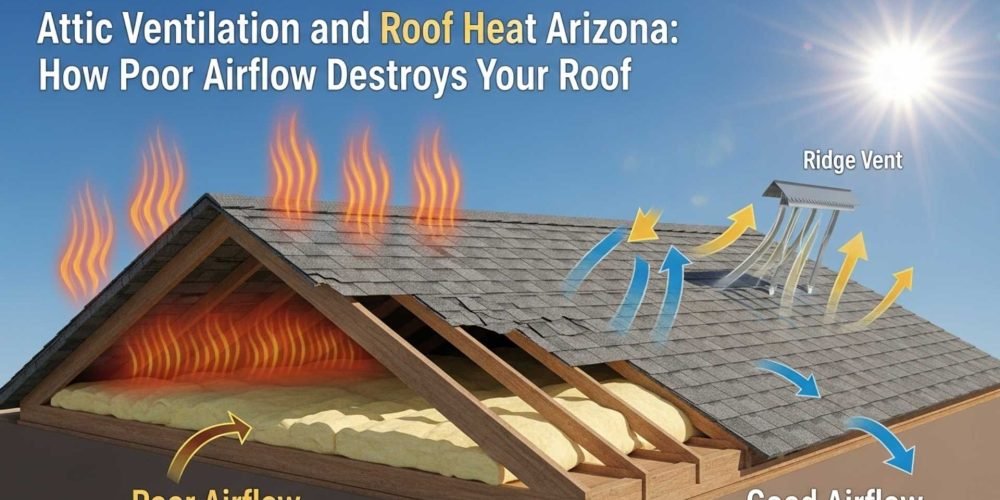
On a typical Phoenix summer afternoon with an outdoor air temperature of 110 degrees Fahrenheit, the surface temperature of a dark or medium-colored roof can reach 160 to 180 degrees Fahrenheit under direct sun. That superheated surface radiates energy downward into the attic space. Without adequate airflow to carry that heat out of the attic, temperatures inside the space accumulate rapidly.
In an inadequately ventilated Phoenix attic, temperatures regularly reach 150 to 165 degrees Fahrenheit during peak summer afternoons. In some cases — particularly in attics with dark roofing materials, limited overhang, and minimal ventilation — temperatures above 170 degrees have been recorded.
These are not temperatures that any roofing material, adhesive, sealant, or underlayment product was engineered to tolerate continuously for months at a time, year after year. The damage they cause is not dramatic or sudden — it is cumulative, accelerating, and largely invisible until it manifests as premature roofing failure or uncontrolled water intrusion.
A properly ventilated Phoenix attic — one with balanced intake at the soffits and exhaust at the ridge — typically runs 20 to 30 degrees cooler than an inadequately ventilated one under the same outdoor conditions. That temperature differential, sustained across every summer day for the life of the roof, is the difference between roofing materials reaching their rated service life and falling significantly short of it.
The Specific Damage That Attic Heat Causes to Arizona Roofs
Extreme attic heat in Phoenix does not damage roofing systems in a general, vague way. It attacks specific components through specific mechanisms — and understanding those mechanisms explains why the consequences of poor ventilation show up where they do.
Underlayment Breakdown
The waterproof membrane beneath your tiles or shingles is the most heat-sensitive critical component in your entire roof assembly. Underlayment — whether felt-based or synthetic — relies on polymer and bitumen compounds for its flexibility and waterproofing properties. Those compounds begin breaking down at sustained temperatures well below what an inadequately ventilated Phoenix attic regularly achieves.
At 150 to 165 degrees, the oils and plasticizers that keep underlayment flexible cook out of the material. It becomes brittle. It cracks along fold lines, at fastener points, and at the laps where sheets overlap. Once cracks develop, the membrane no longer functions as a continuous waterproof barrier — water that penetrates the tile above finds a direct path to the deck below.
This is the mechanism behind one of the most consistent patterns in Phoenix roofing: tile roofs that look perfectly intact from the street but are actively leaking through failed underlayment. The tiles above are shielded from direct UV by their profile and mass. The underlayment beneath is being cooked by attic heat from below, invisibly, every summer. Our guide on when to replace tile roof underlayment in Arizona covers the specific age thresholds and warning signs that indicate underlayment failure — and attic heat is central to understanding why those thresholds are shorter in Arizona than in any other climate.
A properly ventilated attic running 20 to 30 degrees cooler than an inadequately ventilated one extends underlayment service life meaningfully — potentially adding 5 to 10 years to the maintenance interval before replacement becomes necessary.
Shingle Granule Loss and Brittleness
For Phoenix homes with asphalt shingle roofs, attic heat operates as a secondary UV exposure source attacking the shingles from below while direct sunlight attacks from above. Shingles are designed to handle heat — but not the combination of direct sun from above and sustained 160-degree radiant heat from the attic below.
At extreme attic temperatures, the asphalt base of the shingle softens and the volatile oils that maintain flexibility accelerate their evaporation. This drying-out process is what causes shingles to become brittle, lose granule adhesion, develop surface cracking, and ultimately fail to maintain their seal tabs. A shingle roof rated for 25 years in a moderate climate may show these failure characteristics in 12 to 15 years on a poorly ventilated Phoenix home.
If you are evaluating the full picture of how Phoenix heat reduces roof lifespan, inadequate attic ventilation is one of the primary amplifying factors — not the heat itself in isolation, but the combination of direct UV exposure from above and radiant attic heat from below working on the same material simultaneously.
Roof Deck Deterioration
The plywood or OSB sheathing that forms the structural base of your roof is not immune to the effects of sustained extreme heat. The adhesives that bond plywood veneers together are designed for structural performance under normal temperature ranges. Sustained exposure to 150-plus-degree attic temperatures causes those adhesives to break down progressively — a process called delamination, where the plywood layers begin to separate.
Delaminated roof decking loses structural integrity. Fasteners — roofing nails and screws — lose their holding strength in delaminated plywood. The deck loses its ability to function as a stable substrate for the roofing material above it.
The discovery of delaminated or deteriorated deck sections during a roofing project adds significant cost to the scope — not because the deck was old, but because it was operated under conditions it was not designed to withstand continuously. Adequate attic ventilation is the single most effective protection for roof deck longevity in Phoenix’s climate.
Sealant and Flashing Failure
Every roofing system relies on sealants — at pipe boots, skylight perimeters, chimney base flashings, and dozens of other transition points across the roof surface. Those sealants are rated for specific temperature ranges and UV exposure levels. In a Phoenix attic environment, the combination of extreme heat from below and UV from above accelerates sealant degradation significantly beyond manufacturer specifications developed for moderate climates.
Sealants that dry out, shrink, and crack from heat stress create water entry points at every transition where they were the last line of waterproofing defense. This is a primary mechanism behind the pattern of roof flashing failures in Phoenix — the metal itself may be sound while the sealant at every edge has cracked and separated, leaving gaps that monsoon rain exploits efficiently.
Ridge Cap and Hip Mortar Cracking
On tile roofs, the ridge caps and hip tiles are typically set in mortar — a cement-based material that seals the uppermost courses of tile against wind and water. Mortar is a rigid material with limited tolerance for thermal cycling. At the ridge line of a Phoenix roof — the hottest location on the entire roof assembly — repeated daily expansion and contraction cycles accelerate mortar cracking and separation from the tile surface.
Failed ridge mortar allows wind to get beneath the cap tiles and displace them during monsoon storms, and allows water to enter the ridge assembly directly. Repointing deteriorated ridge mortar is a standard maintenance item on Phoenix tile roofs — but poor attic ventilation accelerates the deterioration rate and compresses the maintenance interval.
How Attic Heat Affects Your Energy Bills in Phoenix
The structural damage to roofing components is the long-term consequence of poor attic ventilation. The immediate, monthly consequence shows up on your electricity bill.
When your attic is 160 degrees Fahrenheit, that thermal mass radiates heat downward through your ceiling insulation continuously throughout the afternoon and into the evening. Your insulation resists that heat transfer — but not perfectly, and not indefinitely when the differential between the attic above and the conditioned space below is extreme.
The result is a radiant heat load on your living space that your air conditioning system must continuously overcome. Your AC runs longer, works harder, and consumes more electricity than it would if the attic above were 20 to 30 degrees cooler. In Phoenix, where summer cooling accounts for a disproportionate share of annual electricity consumption, this additional load translates to real, measurable money.
Properly addressing attic ventilation deficiencies in Phoenix homes has been shown to reduce cooling costs by 10 to 20 percent in cases where the existing ventilation was significantly inadequate. For a Phoenix home spending $300 to $400 per month on summer cooling, a 15 percent reduction represents $45 to $60 per month — $270 to $360 across a six-month cooling season — year after year for the life of the improved ventilation system.
The cost of addressing most attic ventilation deficiencies in Phoenix — adding ridge venting, clearing blocked soffits, installing supplemental exhaust — typically ranges from $500 to $1,500 for a residential property. The payback period in energy savings alone, separate from the extended roofing component life, is often measured in a few years rather than decades.
If you are preparing your roof for Phoenix’s extreme summer conditions, our guide on getting your roof ready for Phoenix metro summer heat covers the full range of pre-summer preparations — with ventilation assessment as a foundational step before any other work is planned.
How Attic Ventilation Works in an Arizona Roof
Effective attic ventilation in Arizona requires two components working together — intake and exhaust — in a balanced configuration that allows continuous airflow through the attic space.
Intake Ventilation
Intake ventilation brings outside air into the attic at the lowest point of the roof assembly — typically through soffit vents installed in the underside of the roof overhang along the eave line. As cooler outside air enters at the soffit, it displaces the superheated air accumulating in the attic above, driving it toward the exhaust points at the ridge.
Intake is frequently the limiting factor in Phoenix attic ventilation performance. Many existing Valley homes have soffit vents that are undersized, blocked by insulation pushed to the eaves during installation, or painted over during exterior repainting — all of which restrict or eliminate the intake airflow that the entire ventilation system depends on.
The fix for blocked or inadequate soffit ventilation typically involves clearing existing vents, installing insulation baffles between rafters at the eave to maintain the airflow channel regardless of insulation depth, and in some cases adding continuous soffit ventilation where individual vents are insufficient.
Exhaust Ventilation
Exhaust ventilation allows superheated air to escape from the highest point of the attic — typically through ridge vents running continuously along the roof peak, box vents positioned near the ridge, or powered attic fans.
Ridge vents are the most effective passive exhaust option for most Phoenix residential roofs. Running the full length of the ridge, they allow heated air to escape simultaneously from every section of the attic rather than from isolated points. Modern baffled ridge vents prevent weather infiltration while providing maximum net free area for airflow.
Where roof geometry prevents effective ridge venting — hip roofs with limited ridge length, for example — box vents distributed across the upper roof surface provide exhaust capacity. Solar-powered attic fans are an effective active ventilation option for Phoenix homes where passive ventilation alone cannot achieve adequate airflow given the roof’s geometry or construction.
Our dedicated guide on roof ventilation in Phoenix AZ covers every ventilation type used in the Valley in detail — including performance characteristics, cost ranges, and the specific situations where each approach is most appropriate.
The Balance Requirement
Intake and exhaust must be balanced to function effectively. A roof with substantial ridge venting but inadequate soffit intake cannot draw sufficient replacement air through the assembly — the exhaust capacity goes largely unused. A roof with extensive soffit intake but inadequate exhaust accumulates heat despite the incoming airflow because the hot air has nowhere efficient to exit.
The building code minimum — 1 square foot of net free ventilation area per 150 square feet of attic floor area, split equally between intake and exhaust — is a minimum standard, not an optimization target. For Phoenix’s extreme conditions, meeting or exceeding this ratio with properly balanced intake and exhaust is the baseline expectation for a well-performing ventilation system.
Signs Your Phoenix Attic Ventilation Is Inadequate
Several observable indicators suggest that a Phoenix home’s attic ventilation is insufficient or malfunctioning. Recognizing these signs prompts the right intervention before roofing components fail prematurely.
Higher than expected cooling bills relative to your insulation level. If you have adequate insulation depth but energy bills remain high during Phoenix summers, attic heat radiating through the ceiling is a primary suspect. An attic temperature assessment during peak afternoon hours provides a direct measurement of the problem.
Roofing materials failing ahead of their expected service life. Underlayment needing replacement significantly before the 20 to 25-year Arizona average, shingles showing brittleness and granule loss at 12 to 15 years, or recurring flashing sealant failures are all consistent with the accelerated degradation that poor attic ventilation produces. If your roof is showing signs of premature failure, a ventilation assessment should be part of the diagnostic process before any roofing work is planned.
Visible absence of soffit vents or ridge vents. A walk around the exterior of your home can reveal obvious deficiencies. No visible soffit venting along the eave line, or no ridge vent or box vents near the roof peak, indicates a ventilation system that is almost certainly inadequate for Phoenix’s attic heat levels.
Excessively hot upper floor ceilings. Ceilings on the top floor of a home that feel warm to the touch during afternoon hours indicate heat radiating downward from an overheated attic. This is a direct physical sign of the radiant heat load that poor ventilation creates.
Delaminated or darkened decking visible during a roofing project. If a contractor performing roofing work exposes the deck and finds delaminated plywood or darkened, dried-out decking, these are signs of sustained thermal stress that ventilation improvement should address before the new roofing system is installed above it.
What to Do If Your Phoenix Attic Ventilation Is Inadequate
Addressing attic ventilation deficiencies in Phoenix is a concrete, solvable problem — and one that should be approached systematically rather than reactively.
The starting point is a professional assessment that measures current ventilation capacity against the attic floor area it serves. A licensed Phoenix roofing contractor can assess existing soffit intake, exhaust capacity, and balance — and identify specifically what is deficient and what intervention is appropriate for your roof’s geometry and construction.
Common interventions for Phoenix homes with inadequate ventilation include clearing blocked or painted-over soffit vents, installing insulation baffles at the eaves to maintain the intake pathway, adding continuous soffit ventilation along undersized eave sections, installing or replacing ridge venting along the roof peak, adding box vents near the ridge where geometry prevents continuous ridge venting, and installing solar-powered attic fans where passive ventilation cannot achieve adequate airflow.
When a roofing project is already planned — underlayment replacement, full re-roof, or significant repair — addressing ventilation deficiencies at the same time is both practical and cost-effective. The contractor is already mobilized, the roof is already being accessed, and the cost of adding ventilation improvements to the project scope is lower than returning for a separate mobilization later.
Our Phoenix metro roof maintenance checklist includes ventilation assessment as a routine item — because identifying and addressing ventilation issues before they cause roofing component failure is always less expensive than addressing them after the damage has accumulated.
Attic Ventilation and Roof Warranty in Arizona
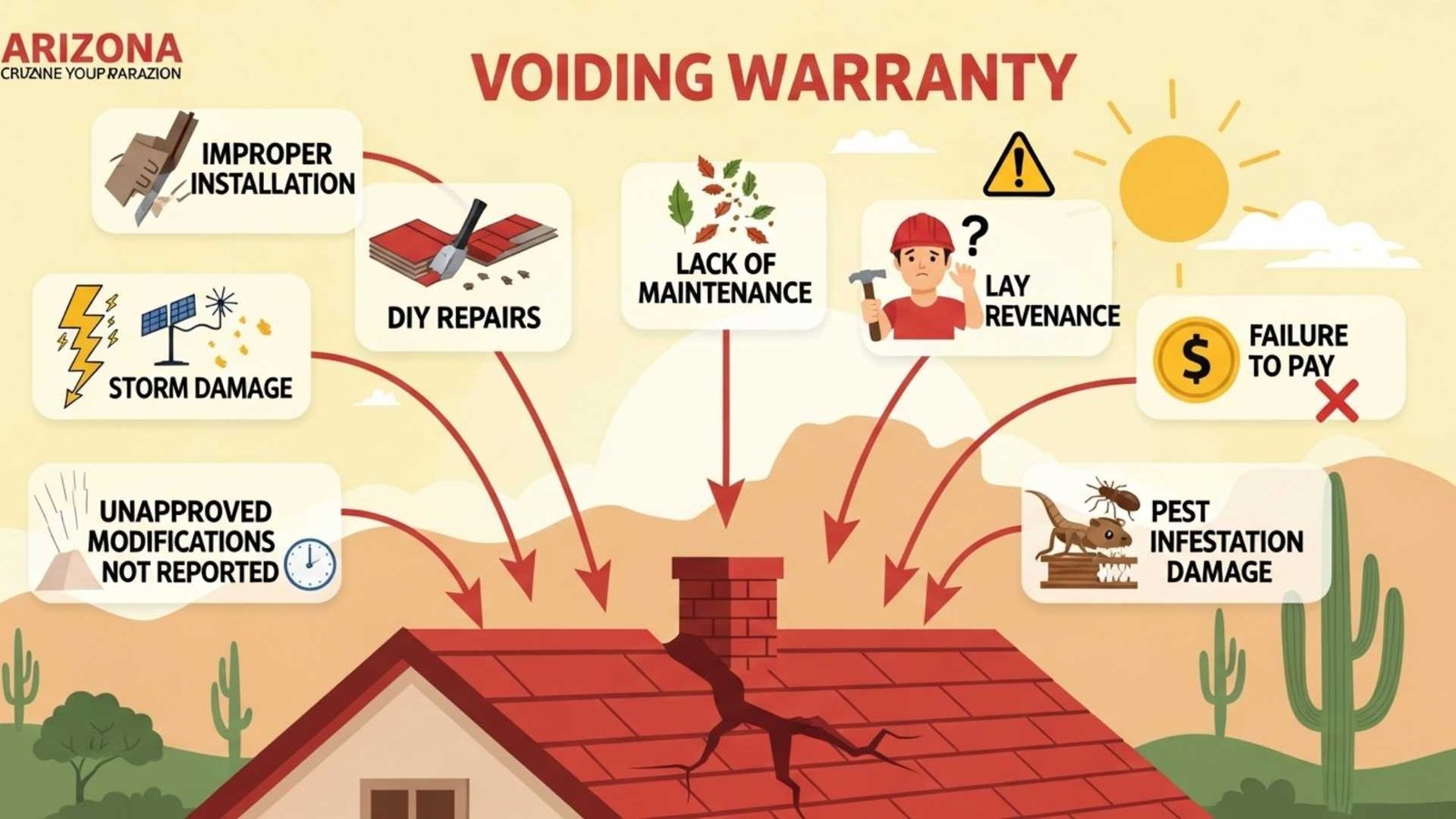
The connection between attic ventilation and roof warranty coverage in Arizona is direct and consequential. Most shingle and underlayment manufacturer warranties specify minimum ventilation requirements — typically expressed as a net free ventilation area ratio — as a condition of coverage.
The logic from the manufacturer’s perspective is straightforward. Their warranty covers material failures under normal operating conditions. A shingle or underlayment operating above a 160-degree inadequately ventilated attic is not operating under normal conditions — it is operating under conditions that the manufacturer’s specifications explicitly exclude from coverage.
When a warranty claim is filed for prematurely failed roofing materials in Arizona, the manufacturer’s inspection process routinely includes assessment of attic ventilation. Inadequate ventilation found during that inspection gives the manufacturer clear grounds to deny the claim. Understanding what voids roof warranty in Arizona — including the ventilation requirement — is essential for any Phoenix homeowner who intends to rely on warranty coverage if materials fail prematurely.
Ensuring your attic ventilation meets or exceeds the minimum specified in your roofing system’s warranty documentation is both a performance decision and a warranty protection decision.
Frequently Asked Questions
How hot does a Phoenix attic actually get in summer?
In an inadequately ventilated Phoenix attic on a peak summer afternoon, temperatures of 150 to 165 degrees Fahrenheit are common. In extreme cases with dark roofing and very limited ventilation, temperatures above 170 degrees have been recorded. A properly ventilated attic under the same outdoor conditions typically runs 20 to 30 degrees cooler — a difference that translates directly into extended roofing component life and reduced cooling costs.
Will adding attic ventilation really lower my energy bills in Phoenix?
Yes — measurably so in cases where the existing ventilation was significantly inadequate. Properly ventilated attics reduce the radiant heat load on the living space below, which directly reduces air conditioning demand. Reductions of 10 to 20 percent in cooling costs are realistic for Phoenix homes upgrading from materially deficient ventilation. The payback period in energy savings alone is typically a few years for most Phoenix residential ventilation improvements.
Can I add attic ventilation to an existing Phoenix home?
Yes. Ridge vents, box vents, soffit vents, and solar-powered attic fans can all be added to existing Phoenix homes without major structural modification. The scope and cost depend on the current ventilation configuration and roof construction. Adding ventilation is one of the most accessible and highest-return roofing improvements available to Valley homeowners.
Does attic ventilation help with monsoon season as well as summer heat?
Yes — though in a different way. During monsoon season, adequate attic ventilation manages moisture that enters the attic assembly through minor infiltration points — preventing the condensation and moisture accumulation that can degrade decking and framing. An attic that breathes well year-round is more resistant to both thermal and moisture damage than one that is sealed or poorly ventilated across both the summer heat season and the monsoon moisture season.
What is the right amount of attic ventilation for a Phoenix home?
The building code minimum is 1 square foot of net free ventilation area per 150 square feet of attic floor area, balanced equally between intake at the soffit and exhaust at the ridge. In Phoenix’s extreme conditions, meeting this minimum with properly balanced intake and exhaust is the baseline. Many experienced Phoenix roofing contractors recommend exceeding the minimum — particularly for homes with dark roofing materials, limited overhangs, or complex roof geometries that restrict natural airflow. A professional assessment against your specific attic floor area is the most accurate way to determine the right specification for your home.
Should I cover attic vents in Phoenix during winter?
No. Year-round ventilation is the correct approach in Phoenix. Even in winter, continuous airflow through the attic manages moisture and maintains the performance of roofing materials. Blocking vents seasonally is not recommended and is unnecessary given Phoenix’s mild winters — the few weeks of cold weather the Valley experiences do not justify compromising the ventilation system’s year-round performance.
Get Your Attic Ventilation Assessed Across Arizona
At Reliable Roofing Near Me, we assess attic ventilation as part of every roof inspection we perform across Phoenix and more than 40 Arizona cities. If your energy bills are higher than your insulation level justifies, your roofing materials are aging faster than expected, or you simply do not know whether your current ventilation is adequate for Phoenix’s conditions, we will give you a clear, honest assessment and a specific recommendation for what your roof needs.
Call us at (480) 867-9986 or visit reliableroofingnearme.com to schedule your free roof and ventilation inspection today. We serve Phoenix, Scottsdale, Mesa, Chandler, Gilbert, Glendale, Peoria, Tempe, Surprise, and every community across the Valley.
Reliable Roofing Near Me | (480) 867-9986 | reliableroofingnearme@gmail.com | reliableroofingnearme.com | 12428 N 28th Dr Suite 12430, Phoenix, AZ 85029 | ROC License #355096